Tree Cabling vs Removal — What an Arborist Would Pick
Tree roots can lift sidewalks and crack foundations. Learn how to prevent costly damage, identify warning signs, and choose the right solution.
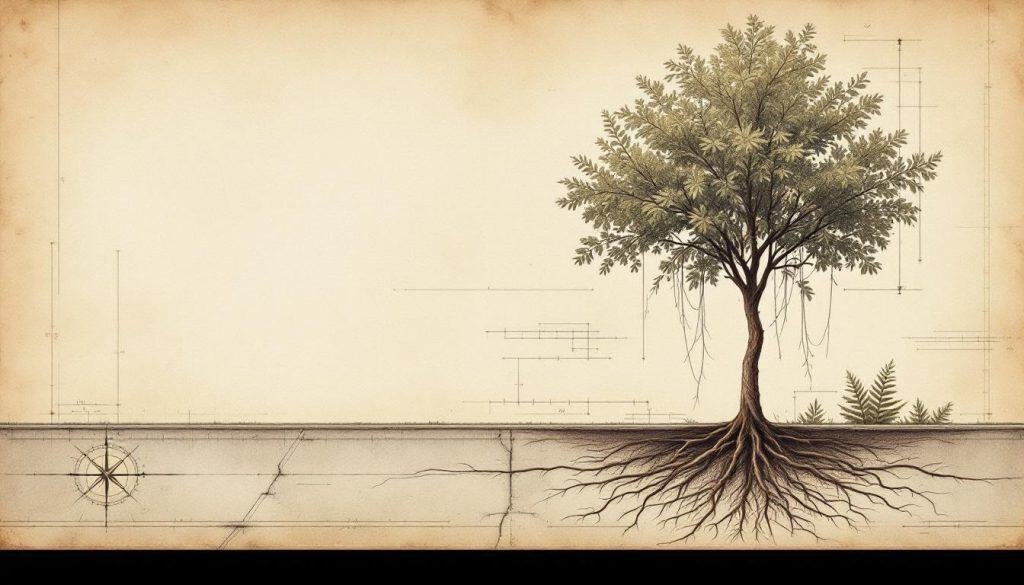
- Tree roots spread 2-3x canopy width, mostly in top 18 inches of soil. Sidewalk lifting begins when roots exploit existing cracks and expand 1-2 inches annually. Foundation damage occurs when large roots alter soil moisture, causing differential settlement. Install barriers 5 feet from foundations, 3 feet from sidewalks during new construction. Consult a Master Arborist before cutting roots within 3x trunk diameter from the base.
You noticed the sidewalk lifting last month, but now there’s a visible crack in your foundation wall. The mature maple planted 15 feet from your house has become more than shade—it’s becoming an expensive liability. Tree roots don’t randomly attack concrete; they follow moisture, nutrients, and oxygen, often finding their way into the smallest gaps where they expand over time.
As Michael J. Hartman, ISA Board Certified Master Arborist, I’ve diagnosed hundreds of these conflicts between trees and infrastructure. Property owners face a critical decision: remove a valuable tree and risk foundation settlement, or implement targeted solutions that preserve both the tree and the structure. Understanding how roots actually behave will save you thousands in unnecessary tree removal or foundation repairs.
How Tree Roots Actually Grow and Cause Damage
Tree roots operate on simple principles: they grow where conditions support life. Fine absorbing roots concentrate in the top 18 inches of soil, spreading 2-3 times the canopy width. When these roots encounter concrete, they don’t possess the strength to punch through solid material. Instead, they exploit existing flaws—construction joints, shrinkage cracks, or areas where soil has settled beneath the slab.
Here’s where the real damage begins: as roots increase in diameter by just 1-2 inches annually, they create tremendous lateral pressure. A 4-inch diameter root can exert over 3,000 pounds of force per square foot. This pressure compounds when multiple roots converge beneath a slab, creating a hydraulic effect that literally lifts concrete. The process accelerates when roots thicken after finding consistent moisture sources from leaking pipes or poor drainage.
Foundation damage occurs differently. Most residential foundations extend 30-48 inches below grade—directly into the primary root zone. When roots penetrate foundation cracks, they don’t just widen gaps; they modify soil moisture patterns. Large roots can extract 100-200 gallons of water daily during peak growth, creating localized soil shrinkage that causes differential settlement.
Early Warning Signs of Root-Related Infrastructure Damage
Root damage announces itself subtly before becoming catastrophic. Walk your property every spring and fall, documenting any changes. Look for slabs that have shifted by more than ¼ inch relative to adjacent sections—this exceeds normal thermal expansion tolerance and indicates active root pressure.
Warning Signs to Watch For
- Sidewalk gaps: Separation exceeding ½ inch between sections, especially where slabs meet vertical surfaces
- Foundation cracks: Diagonal cracks starting at corners of windows/doors, wider at top than bottom
- Driveway lifting: Sections tilting toward the tree, creating trip hazards exceeding ¾ inch
- Interior indicators: Doors/windows sticking, cracks in drywall following corner angles
Measure crack widths using a simple crack gauge or credit card edge. Foundation cracks wider than ¼ inch warrant immediate professional assessment. Document everything with dated photos—this creates a timeline essential for insurance claims and arborist evaluations. Pay special attention to north-facing walls where tree shade maintains consistent moisture levels that favor root growth.
The species matters enormously. Silver maples, willows, and poplars cause 60% of root-related infrastructure damage I investigate. These fast-growing species produce aggressive surface roots that can extend 40-50 feet from the trunk. Conversely, oaks and pines typically cause less damage due to their deeper, more radial root architecture.
Assessing Root Damage: Professional vs DIY Evaluation
Before calling professionals, conduct a preliminary assessment. Measure the tree’s diameter at breast height (4.5 feet above ground). For every inch of trunk diameter, roots typically extend 1-1.5 feet. A 20-inch diameter maple likely has roots reaching 20-30 feet—potentially affecting your entire yard.
Use a probe rod or long screwdriver to locate major roots. Insert every 6 inches in a grid pattern, marking where you encounter resistance more than 12 inches deep. This creates a root density map revealing whether damage correlates with root concentration. Document any areas where probes meet solid obstructions at shallow depths.
Tools You Will Need
- Measuring tape: 100-foot tape for accurate distance measurements from trunk
- Crack gauge: Specifically designed for concrete, measures widths from 1/32 to ½ inch
- Probe rod: 36-inch steel rod with T-handle for subsurface exploration
- Level: 4-foot contractor’s level to measure slab displacement
Professional evaluation becomes essential when damage exceeds $5,000 in estimated repair costs or when tree removal might be necessary. Certified arborists use ground-penetrating radar to map roots without excavation and can calculate whether root pruning will compromise tree stability. They also understand local ordinances—many cities protect mature trees over 24 inches diameter, requiring permits for removal.
Prevention Strategies During New Construction
New construction offers the best opportunity to prevent conflicts. Install root barriers during initial landscaping, positioning them 5 feet from foundations and 3 feet from sidewalks. Use 40-mil HDPE barriers extending 36 inches deep with a 6-inch outward flare at the bottom to deflect roots downward.
Plan tree placement using the mature canopy spread, not the nursery tag size. A red maple tagged as “25-foot spread” will actually reach 35-40 feet at maturity. Position large species minimum 20 feet from structures, medium trees 15 feet, and small ornamentals 8 feet. Consider directional planting—locate trees where mature growth won’t impact infrastructure.
Soil preparation prevents 70% of future conflicts. Create planting islands with structural soil (compacted stone and soil mix) beneath sidewalks, allowing both root growth and load-bearing capacity. Install pervious concrete sections near trees, providing 15-20% air space that accommodates root expansion without heaving.
Targeted Root Pruning and Barrier Installation
Root pruning requires precision—cutting the wrong roots can destabilize or kill your tree. Identify roots to cut using the 3x rule: never sever roots closer than 3 times the trunk diameter from the base. For a 12-inch diameter tree, maintain a 36-inch minimum distance from the trunk when cutting major roots.
Use clean, sharp tools appropriate for root size. Hand pruners work for roots under ½ inch, loppers up to 1 inch, and a sharp pruning saw for larger roots. Make clean cuts at 45-degree angles to minimize tearing and promote callus formation. Never use chainsaws below ground—they create ragged cuts prone to decay.
When to Act
Best window: Late fall through early spring during dormancy. Roots pruned during active growth trigger compensatory sprouting that can worsen conflicts within 2-3 years.
Install barriers after pruning. Position barriers 6 inches beyond the furthest root you intend to cut, angled 15 degrees away from the tree. Backfill with sharp gravel to prevent roots from growing over the barrier. Compact soil in 6-inch lifts to prevent settling that creates pathways for future root growth.
Repair Techniques for Damaged Concrete and Foundations
Sidewalk lifting under 2 inches often requires simple grinding. Rent a concrete grinder for $75-100 daily and reduce raised edges to create 1:8 slope transitions compliant with ADA requirements. This preserves both the tree and sidewalk while costing 90% less than replacement.
Moderate lifting (2-4 inches) benefits from mudjacking or polyurethane foam injection. These techniques pump material beneath slabs to restore grade without disturbing roots. Costs run $5-8 per square foot versus $15-25 for complete replacement. Ensure contractors understand root locations to avoid drilling through major roots during injection.
Foundation repairs demand engineering assessment. Stitching cracks with carbon fiber straps costs $500-1,500 per crack and prevents further movement. Major displacement requires underpinning with helical piers installed beyond the root zone. Budget $300-500 per pier; most residential corners need 4-6 piers for permanent stabilization.
Pro Tip: Always repair foundations before addressing cosmetic damage inside. I’ve seen homeowners spend $20,000 on interior repairs only to have cracks reopen within a year because the underlying root issue wasn’t resolved.
When Tree Removal Becomes Necessary
Tree removal becomes the only option when structural integrity is compromised and no other solutions protect both tree and property. This typically occurs when major supporting roots on the building side must be removed to stop foundation damage, leaving insufficient root mass for stability.
Calculate removal necessity using the 30% rule: if root pruning requires removing more than 30% of the critical root zone (1 foot radius per inch of trunk diameter), the tree will likely fail within 5-10 years. Combined with foundation repair costs exceeding 50% of the tree’s appraised value, removal becomes economically justified.
Stump grinding depth matters for future construction. Standard grinding to 6-8 inches suffices for lawns, but foundation repairs require 18-24 inch depth to prevent regrowth and allow proper compaction of fill materials. Specify complete root chasing where the grinder follows major roots 5-6 feet from the stump.
Legal and Insurance Considerations
Property owners bear legal responsibility for maintaining trees and preventing damage to neighboring properties. Most insurance policies exclude “gradual damage” from roots, considering it preventable through proper maintenance. Document regular inspections every 3-5 years with certified arborists to demonstrate due diligence.
When damage affects city sidewalks, responsibility varies by municipality. Some cities assume maintenance, others bill homeowners. Request city inspections before repairs—unauthorized work can result in fines or requirements to remove and redo improvements to city specifications costing 3-4 times more.
Neighbor disputes require professional documentation. If roots from a neighbor’s tree damage your property, certified arborist reports carry legal weight in small claims court. Most cases settle when documentation shows the tree owner neglected obvious hazards for 2+ years after notification.
What to Do Next: Your Action Plan
Start with immediate documentation. Photograph all damage with a tape measure for scale, date the images, and create a simple sketch showing tree locations relative to damage. This baseline protects you legally and helps professionals assess whether damage is active or historic.
Schedule assessments based on severity. For cracks under ¼ inch with no displacement, perform annual monitoring yourself. Wider cracks or any foundation movement warrant immediate professional evaluation—expect $300-500 for arborist assessment and $500-800 for structural engineer if foundation involvement is suspected.
Implement preventive measures on unaffected areas. Install root barriers around young trees before they reach 6 inches diameter—cost increases exponentially with tree size. Budget $15-25 per linear foot for professional barrier installation, or $5-8 per foot for DIY installation on new plantings.
Remember: every day of delay increases repair costs. A lifted sidewalk that could be ground for $200 today becomes a $2,000 replacement project after roots thicken another season. Foundation cracks that could be sealed for $500 become $15,000 structural repairs once roots penetrate and expand. Act now while options remain affordable and trees can be saved.