Coconut Bud Rot Prevention: A Practical Guide
Coconut bud rot kills palms fast and silently. Learn how to prevent it, spot early symptoms, and decide when professional intervention is your only option.
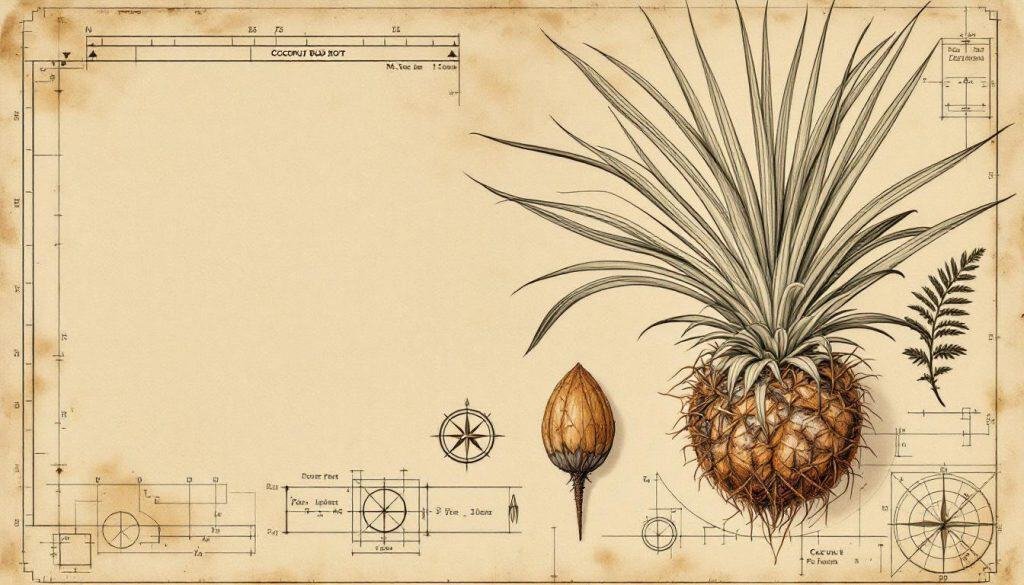
- Coconut palms have one apical meristem — destroy it and the tree cannot recover under any circumstances.
You walk past your coconut palm on a Tuesday morning and notice the newest spear leaf looks a little off — slightly discolored, maybe leaning at an odd angle. By Friday it pulls out with almost no resistance. That single observation is one of the most alarming things a palm owner can witness, because it often means Phytophthora palmivora or a related pathogen has already reached the growing point. Coconut bud rot is not a slow disease. It moves from first visible symptom to irreversible crown collapse in a matter of weeks under the right conditions.
Coconut palms (Cocos nucifera) are monocots with a single apical meristem — the bud — located at the very top of the trunk. Unlike a broadleaf tree that can push new growth from dozens of dormant buds, a coconut has exactly one. Destroy that bud and the tree is finished. There is no recovery, no regrowth, no second chance. That biological reality is why prevention is not just the best strategy for coconut bud rot — it is the only strategy that consistently works. I’m Michael Hartman, ISA Board Certified Master Arborist (TX-0198B), and in this guide I’ll walk you through the biology of the disease, the environmental conditions that trigger outbreaks, the fungicide and cultural practices that actually reduce risk, and the decision points that tell you when a tree is worth treating versus when removal is the responsible call.
By the end of this article you will understand why bud rot spreads the way it does, what a prevention program looks like across a full calendar year, and how to avoid the most common mistakes homeowners and even landscapers make when they try to manage this disease on their own.
The Biology Behind Coconut Bud Rot
Coconut bud rot is caused primarily by Phytophthora palmivora, a water mold classified as an oomycete rather than a true fungus. This distinction matters practically because oomycetes do not respond to many standard fungicides — products that work against Botrytis or Fusarium may do nothing against Phytophthora. The pathogen produces motile zoospores that swim through free water, which is why standing moisture in the crown is the single biggest risk factor for infection.
The organism overwinters in soil and infected plant debris, then releases zoospores during warm, wet weather. Zoospores travel upward through rain splash, irrigation overspray, or water pooling in the crown’s leaf axils. Once they reach the tender tissue at the base of the spear leaf — the youngest, most vulnerable tissue on the palm — they penetrate within hours. The infection then moves downward toward the meristem. By the time you see the spear leaf rotting, the pathogen may already be 6 to 10 centimeters into the crown tissue below it.
Apical Meristem: The single zone of actively dividing cells at the growing tip of a palm. In coconut palms, this tissue sits at the base of the crown and produces every new leaf. Because palms have only one, any disease that destroys it kills the entire tree.
Secondary pathogens including Thielaviopsis paradoxa and various Fusarium species can compound the damage once Phytophthora breaches the crown’s natural defenses. Bacterial soft rot organisms often follow, accelerating tissue breakdown and producing the foul odor that characterizes advanced infections. Understanding this cascade is important because it means early intervention — before secondary colonizers arrive — gives you the best chance of saving a tree that still has an intact meristem.
Identifying Bud Rot Before It Becomes Fatal
Early diagnosis is genuinely difficult because the first symptoms appear inside the crown, hidden by surrounding fronds. Most property owners don’t notice anything wrong until the spear leaf — the tightly rolled youngest leaf — either fails to unfurl normally or pulls free with minimal force. At that stage the infection is already advanced.
Warning Signs to Watch For
- Spear leaf discoloration: The youngest rolled leaf turns pale yellow, brown, or grayish before the surrounding fronds show any change. This is often the first externally visible sign.
- Easy spear pull: A healthy spear leaf requires significant force to remove. If it slides out with light hand pressure, the tissue at its base has already rotted away.
- Foul odor from the crown: A sour, fermented, or sulfurous smell rising from the top of the palm indicates active tissue decomposition, often involving bacterial secondary infection.
- Water-soaked lesions on petioles: Dark, greasy-looking patches at the base of fronds near the crown indicate active Phytophthora colonization spreading outward from the meristem.
- Crown collapse: The entire canopy leans or folds inward as the structural tissue of the crown softens. At this stage the meristem is almost certainly destroyed.
If you suspect early infection, probe the crown tissue with a clean, disinfected knife. Healthy meristem tissue is firm, white to cream-colored, and has a mild starchy smell. Infected tissue is brown, soft, and may be visibly wet. The boundary between healthy and diseased tissue is usually sharp in early infections and diffuse in advanced ones. Document what you find with photos before doing anything else — this information is critical if you bring in a professional for a second opinion.
Environmental Conditions That Drive Outbreaks
Bud rot does not appear randomly. Outbreaks cluster around specific environmental triggers, and understanding those triggers lets you time your prevention efforts precisely. Warm temperatures combined with prolonged leaf wetness are the core requirements. In practice, this means the highest-risk windows are the weeks immediately following tropical storms, extended rainy seasons, and periods of high humidity with overnight temperatures above 20°C (68°F).
Irrigation management is a controllable variable that many property owners overlook. Overhead irrigation systems that wet the crown directly create the same free-water conditions that rainfall does, but they do it on a schedule you control. Switching to drip or micro-spray systems that keep water at the root zone — not the canopy — eliminates a significant and entirely avoidable infection pathway. If overhead irrigation is unavoidable, run it in the early morning so crown tissue dries before nighttime temperatures drop and dew forms.
When to Act
Best window: immediately before and during the rainy season or hurricane season (typically June through October in Florida and the Caribbean). Preventive fungicide applications made 2 to 4 weeks before sustained wet weather begins provide the best protection. Waiting until symptoms appear means the pathogen is already inside the crown, and curative success rates drop sharply.
Soil drainage also plays an indirect role. Palms growing in poorly drained sites experience chronic root stress, which reduces their ability to produce the phenolic compounds that slow pathogen advance in crown tissue. Improving drainage around the root zone — even simple surface grading to direct water away from the trunk — reduces overall disease pressure on the tree.
Preventive Fungicide Programs That Work
The most effective preventive chemistry against Phytophthora palmivora belongs to two groups: phosphonate-based products (such as potassium phosphite) and mefenoxam or metalaxyl formulations. These are oomycete-specific and work by interfering with the pathogen’s cell membrane synthesis and sporulation. Standard broad-spectrum fungicides containing chlorothalonil or copper hydroxide have some suppressive activity but are not reliable as standalone preventives against Phytophthora.
Phosphonate products can be applied as foliar sprays, soil drenches, or trunk injections. For coconut palms, crown-directed foliar applications — targeting the spear leaf and the leaf axils at the top of the crown — are the most direct delivery method. Apply at a concentration of 2 to 4 grams of phosphorous acid equivalent per liter of water, using a surfactant to improve penetration into the tightly packed crown tissue. Repeat applications every 4 to 6 weeks during high-risk periods.
Pro Tip: When applying preventive fungicide to a coconut crown, use a backpack sprayer with an extended wand so you can direct the spray into the axils of the youngest three to four fronds — not just onto the outer leaf surfaces. That tight space between the emerging spear and the surrounding fronds is exactly where zoospores accumulate, and it’s the area most applicators miss entirely.
Copper-based bactericides applied to the crown can reduce secondary bacterial soft rot once an infection is underway, but they do not stop Phytophthora. Using copper as a primary preventive is a common and costly mistake. Reserve it as a complement to phosphonate chemistry, not a substitute.
Cultural Practices That Reduce Infection Risk
Fungicide programs work best when paired with cultural practices that reduce the conditions Phytophthora needs to thrive. The most impactful cultural change most property owners can make is tool sanitation. Every pruning cut on a palm is a potential entry point, and contaminated pruning tools are a documented vector for spreading crown pathogens between trees.
Pre-Pruning Sanitation Protocol for Coconut Palms
- Disinfect all cutting tools with a 10% bleach solution or 70% isopropyl alcohol before approaching each tree
- Allow disinfectant to contact tool surfaces for at least 30 seconds before rinsing and drying
- Never use the same blade on a symptomatic tree and a healthy tree without re-disinfecting between cuts
- Bag and remove all pruned material from the site — do not chip infected fronds on-site and spread the mulch near other palms
- Avoid pruning during or immediately after rain events when zoospore counts in the environment are highest
Avoid over-pruning, which is endemic in Florida and coastal communities where landscapers routinely remove green fronds to achieve a tidy appearance. Green fronds below horizontal still photosynthesize and contribute to the tree’s carbohydrate reserves. A palm with depleted reserves has reduced capacity to wall off pathogen advance. The industry standard is to remove only fronds that hang below a 9 o’clock to 3 o’clock horizontal plane — never remove green fronds above that line.
Common Mistakes That Accelerate Bud Rot
Even well-intentioned property owners and landscapers make decisions that increase bud rot risk rather than reduce it. The most damaging errors tend to cluster around three areas: chemical selection, pruning timing, and wound management.
Common Mistakes to Avoid
- Using the wrong fungicide class: Applying products labeled for true fungal diseases (azoxystrobin, propiconazole) against Phytophthora provides little to no protection and creates a false sense of security. Always verify the product label lists oomycete pathogens.
- Pruning during wet weather: Cutting fronds when the crown is wet dramatically increases the chance of introducing zoospores directly into fresh wounds. Schedule pruning for dry periods, with at least 48 hours of dry weather forecast afterward.
- Ignoring the spear leaf during inspections: Many people inspect the outer fronds and declare the tree healthy. The spear leaf is the diagnostic target — check it every two weeks during rainy season.
- Delaying removal of confirmed infected trees: A palm with a destroyed meristem will not recover. Leaving it standing exposes neighboring palms to ongoing inoculum pressure from the rotting crown tissue.
Tools and Materials for a Prevention Program
Executing a coconut bud rot prevention program requires a modest but specific set of tools. Improvising with whatever is in the garage leads to inconsistent application and missed coverage in the crown.
Tools You Will Need
- Backpack sprayer (12-16 liter capacity): Provides enough volume for thorough crown coverage on mature palms; choose a model with a pressure-adjustable wand for precise delivery into tight crown spaces
- Extended spray wand (1.5 to 2 meter reach): Allows crown-directed application from ground level on palms up to 6 meters tall without requiring a lift or ladder
- Phosphonate fungicide concentrate: Potassium phosphite products are widely available; verify the label lists Phytophthora species and follow the dilution rate for ornamental palms specifically
- Non-ionic surfactant: Improves spray adhesion and penetration into the waxy crown tissue; add at 0.1 to 0.25% of spray volume
- Disinfectant spray bottle: Pre-filled with 70% isopropyl alcohol for rapid tool sanitation between trees
Regional and Species-Specific Considerations
Coconut palms grown in South Florida, Hawaii, Puerto Rico, and throughout the Caribbean face the highest bud rot pressure because these regions combine warm temperatures, high humidity, and active hurricane seasons. In these areas, a twice-monthly crown inspection during June through October is not excessive — it is the minimum responsible standard. Palms in drier climates like Southern California face lower baseline risk but remain vulnerable during El Niño years when extended wet periods occur.
Tall-type coconut varieties (the classic arching palms seen on tropical beaches) are generally considered more susceptible to bud rot than compact dwarf varieties, though all Cocos nucifera cultivars are vulnerable. The Malayan Dwarf and its hybrids, including the Maypan variety developed specifically for disease resistance, show somewhat better field tolerance, but “tolerance” is not immunity. Even resistant varieties require preventive management in high-pressure environments.
Young palms under five years old with trunks shorter than 1.5 meters are disproportionately vulnerable because their crowns are accessible to ground-level splash dispersal and their meristems are closer to soil-level inoculum sources. Prioritize these trees in any prevention program.
When to Call a Professional — and When Removal Is the Answer
DIY prevention programs are entirely appropriate for healthy palms in low-to-moderate risk environments. Applying phosphonate sprays, maintaining proper irrigation, and following sanitation protocols during pruning are tasks any attentive property owner can execute. The threshold for professional involvement arrives when you observe any of the diagnostic signs described earlier, when you are managing more than three or four palms in a high-risk zone, or when a palm is tall enough that crown access requires equipment.
A certified arborist brings two things a homeowner cannot replicate: the ability to accurately assess meristem viability through direct crown inspection, and access to trunk injection systems that deliver systemic phosphonate chemistry directly into the vascular tissue without relying on foliar uptake. For palms showing early infection symptoms, a professional injection program combined with surgical removal of infected crown tissue gives the best odds of saving the tree — but only if the meristem is still intact and firm.
If the meristem is destroyed, the decision is straightforward. The tree will not recover. Removal should happen promptly, before the rotting crown tissue becomes a structural hazard and before it continues releasing inoculum onto neighboring palms. Do not let sentiment delay this decision — a dead palm with a rotting crown is an active threat to every other palm on your property.
Building Your Year-Round Prevention Plan
Effective coconut bud rot prevention is not a single treatment — it is a calendar of coordinated actions. Start your program in late spring, 4 to 6 weeks before your region’s rainy season begins. Apply the first preventive phosphonate spray at that time, targeting the crown and upper leaf axils. Repeat every 4 to 6 weeks through the end of the wet season. Conduct visual inspections of the spear leaf every two weeks during peak risk months. Schedule any necessary pruning for dry periods, always with sanitized tools.
In the dry season, shift focus to soil health and irrigation management. Ensure drainage is adequate, correct any irrigation heads that wet the crown, and address any nutrient deficiencies — particularly potassium and magnesium, which are commonly deficient in sandy coastal soils and directly affect a palm’s stress tolerance. A palm growing in nutritionally balanced, well-drained soil with appropriate irrigation is a fundamentally harder target for Phytophthora than one under chronic stress. Prevention, done right, is mostly about removing the conditions the pathogen needs — and that work happens year-round, not just when the rain starts falling. For more detail on pathogen biology and environmental triggers, consult University of Florida research.