Tritucap vs Mulcher Chip Size: Which Is Right for You
Choosing between tritucap and standard mulcher chip sizes affects soil health, equipment wear, and job efficiency. Here's what arborists need to know.
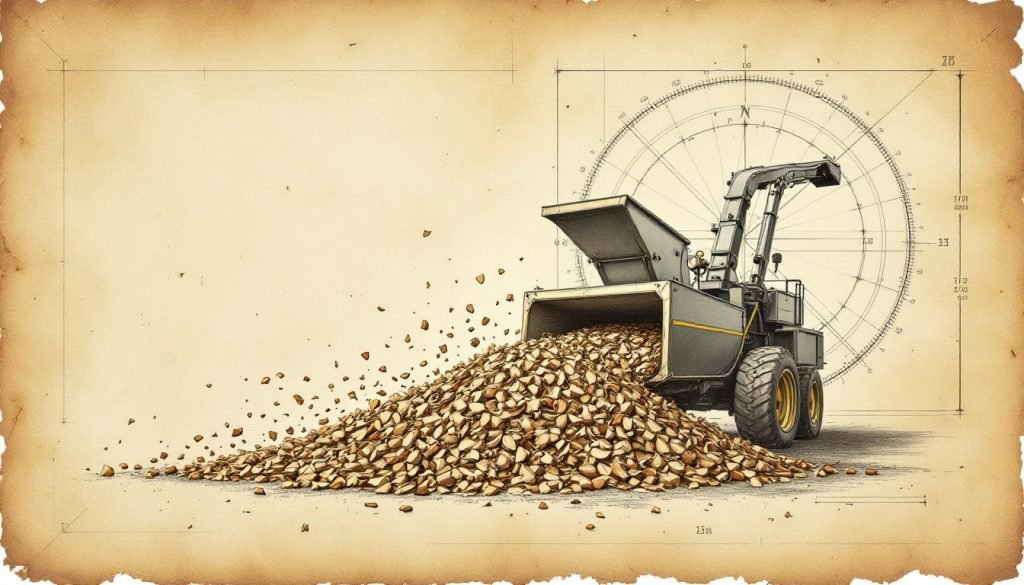
- Tritucap knives produce uniform 1.5–2.5 inch chips with intact cell walls; mulchers produce variable fibrous particles. Fine mulcher output excels at erosion control and pathways where compaction and fiber texture matter. Worn tritucap knives produce ragged chips that behave like mulcher output — inspect every 8–10 operating hours. Match chip size to the specific application before the material leaves the job site, not after it's spread.
You’ve just finished a removal job, the wood chipper is running, and you’re staring at a pile of material that needs to become something useful. The question isn’t just whether to chip or mulch — it’s what size the output should be, and whether your machine’s configuration is actually matched to the task at hand. For crews running drum or disc chippers with tritucap knife systems, the chip size question gets more nuanced than most operators realize. For those using dedicated mulching heads or tub grinders, a different set of tradeoffs applies entirely. Michael Hartman, ISA Board Certified Master Arborist (TX-0198B), has worked with both systems across residential and commercial sites in Texas and sees the same mismatches repeated on job after job.
The core issue is this: tritucap-equipped chippers and standard mulching machines don’t just produce different-looking output — they produce material with fundamentally different physical properties, decomposition rates, and appropriate end uses. Getting that wrong means spreading mulch that competes with tree roots, accelerates nitrogen drawdown, or simply blows off the bed before it does any good. By the end of this article, you’ll understand the mechanical differences between these two output types, how chip size affects soil biology and tree health, and how to match your machine configuration to the specific job you’re doing.
This isn’t a debate about which machine brand wins. It’s about understanding what comes out of the discharge chute and making deliberate decisions about where that material goes and how it’s used.
What Tritucap Actually Means in a Chipping Context
The term tritucap refers to a specific knife and counter-knife geometry used in drum and disc chippers, most commonly associated with Morbark and similar manufacturers. The design uses a three-point carbide-tipped cutting configuration that produces a more uniform, faceted chip compared to traditional straight-knife systems. The geometry of the cut matters because it determines not just chip length but chip thickness and the degree of fiber tearing versus clean slicing through wood cells.
Tritucap: A three-point carbide knife configuration used in drum chippers that produces uniformly sized, faceted wood chips through a slicing rather than tearing action, resulting in more consistent particle geometry than standard straight-knife systems.
In practical terms, a tritucap-equipped chipper running a standard screen will produce chips in the 1.5-inch to 2.5-inch range with relatively consistent thickness — typically 0.25 to 0.5 inches. This is the material arborists and landscape contractors often refer to as “arborist chip” or “ramial chip,” and it behaves very differently from the shredded, fibrous output of a mulching head or tub grinder. The clean cell-wall cuts made by tritucap knives also mean the chips retain more structural integrity during decomposition, which has direct implications for how they interact with soil biology.
Understanding this distinction is the foundation for everything else in this comparison. When someone asks whether tritucap chips or mulcher output is better, they’re really asking two separate questions: better for what purpose, and better for which soil and tree system?
How Mulching Heads and Tub Grinders Produce Different Particle Sizes
Mulching heads — whether mounted on skid steers, excavators, or dedicated mulching machines — use a flail or fixed-tooth rotor to impact and shred material rather than slice it. The result is a fibrous, irregular particle with torn cell walls, variable length from under 0.5 inches to over 4 inches, and a high surface-area-to-volume ratio. Tub grinders produce a similar profile, though operators can dial in particle size more precisely by adjusting screen size and rotor speed.
The fibrous texture of mulcher output is visually appealing and compacts well, which is why it dominates the landscape supply market. However, that torn-fiber structure means the material begins aerobic decomposition faster than clean-cut chips. In hot Texas summers, a 3-inch layer of mulcher output can heat to 130°F internally within two weeks of application, which can damage feeder roots if applied too close to the root flare. Tritucap chips, with their intact cell walls, decompose more slowly and maintain a more stable temperature profile through the mulch layer.
Particle size also affects water infiltration. Research on mulch hydrology consistently shows that coarser, more uniform chips allow better water penetration than fine, compacted mulcher output. A 2-inch tritucap chip layer at 3-inch depth allows roughly 70-80% of rainfall to reach the soil surface, while heavily shredded mulcher material at the same depth can shed 20-30% of light rainfall events before the layer becomes saturated.
The Soil Biology Behind Chip Size Selection
Chip size isn’t just an aesthetic choice — it directly drives the microbial community that develops in the mulch layer and the nitrogen dynamics in the soil beneath it. This is the biological mechanism that most operators overlook, and it’s where getting the size wrong causes real tree health problems.
Fine mulcher output, with its high surface area and torn cell walls, provides an immediate substrate for bacteria-dominated decomposition. Bacterial decomposition is fast, generates heat, and consumes nitrogen rapidly. When fine mulch is applied in thick layers around trees, the carbon-to-nitrogen ratio of the decomposing material — often 400:1 or higher for fresh wood — pulls available nitrogen out of the soil solution, starving feeder roots during the critical spring flush. This is the nitrogen drawdown effect, and it’s most severe with fine-particle mulcher output applied within 18 inches of the trunk.
Pro Tip: When using mulcher output around established trees, pull the material back at least 6 inches from the root flare and limit depth to 2-3 inches maximum. The finer the particle, the more aggressively it depletes soil nitrogen during active decomposition — I’ve seen yellowing on live oaks that cleared up within one growing season simply by replacing fine mulch with coarser arborist chips and pulling material away from the trunk.
Tritucap chips, by contrast, support a fungal-dominated decomposition pathway. Fungal networks process the intact lignin and cellulose more slowly, generate less heat, and actually facilitate nutrient cycling rather than competing for it. For trees — which evolved in forest systems dominated by fungal soil communities — this is the preferred mulch biology. Studies on ramial chipped wood, which shares many properties with tritucap output, show measurable improvements in soil aggregate stability and mycorrhizal colonization rates compared to fine-mulch treatments over a two-to-three-year period.
Comparing Tritucap Chips and Mulcher Output Side by Side
The practical differences between these two material types become clearest when you lay them out against specific use cases. Both have legitimate applications — the mistake is using one where the other is clearly superior.
| Characteristic | Tritucap Chip Output | Mulcher/Tub Grinder Output |
|---|---|---|
| Typical particle size | 1.5–2.5 inches, uniform | 0.25–4 inches, variable |
| Cell wall condition | Clean-cut, intact | Torn, high surface area |
| Decomposition rate | Slow (12–24 months) | Fast (4–10 months) |
| Nitrogen drawdown risk | Low to moderate | High, especially when fresh |
| Water infiltration | High — allows good penetration | Moderate — can compact and shed |
| Best use case | Tree root zones, garden beds | Erosion control, pathways, aesthetics |
| Equipment wear rate | Higher knife maintenance required | Lower per-hour maintenance |
One point the table can’t fully capture is the handling difference on-site. Tritucap chips are heavier per cubic yard and don’t blow around in wind, which matters on residential sites near driveways and hardscapes. Mulcher output is lighter and easier to spread by hand, but it migrates. On a sloped site with any wind exposure, fine mulcher material can redistribute itself significantly within the first few weeks after application.
Equipment Wear and Knife Maintenance Considerations
Tritucap knife systems require more attentive maintenance than the hammers or fixed teeth on a mulching head. The carbide tips on tritucap knives are precision-ground, and running them against soil-contaminated material or dense hardwoods without proper counter-knife clearance accelerates wear significantly. A typical tritucap knife set on a mid-size drum chipper should be inspected after every 8-10 hours of operation and resharpened or replaced when the cutting edge shows more than 0.5mm of rounding.
The payoff for that maintenance discipline is chip quality consistency. A sharp tritucap system produces the same 2-inch chip at hour one and hour eight. A worn system starts producing longer, more fibrous chips as the knife begins tearing rather than slicing — and that output starts to look more like mulcher material than arborist chip. If you’re selling or delivering material for tree care applications and your chips are coming out ragged and variable, the first diagnostic step is knife condition, not machine speed.
Mulching heads and tub grinders are more forgiving of wear because the impact-based cutting mechanism doesn’t rely on a precise edge. Hammer tips and fixed teeth can lose significant mass before output quality degrades noticeably. This makes mulching equipment lower-maintenance per operating hour, but it also means operators are less likely to notice gradual output quality changes — which can matter when material is being specified for a particular application.
Matching Chip Size to Specific Tree Care Applications
The right chip size depends entirely on what you’re trying to accomplish. For mulching around established trees in a landscape setting, tritucap-sized chips in the 1.5-to-2.5-inch range are the professional standard. Apply them 3-4 inches deep in a ring extending to the drip line, keeping material 6 inches clear of the root flare. This configuration suppresses weeds, moderates soil temperature, retains moisture, and supports the fungal soil community that benefits tree root systems.
For erosion control on disturbed slopes or construction sites, mulcher output wins. The fibrous, interlocking texture of shredded material knits together on slopes and resists displacement better than uniform chips. On a 3:1 slope, fine mulcher material at 4-inch depth will hold through moderate rainfall events where tritucap chips would migrate downslope. For this application, the faster decomposition rate is also acceptable since the goal is temporary stabilization rather than long-term soil biology improvement.
Pathway and trail surfacing is another case where mulcher output is appropriate. The compressibility and fine texture create a more walkable surface, and the faster decomposition means the material integrates into the soil base over time without leaving a persistent woody layer. Tritucap chips on a pathway feel unstable underfoot and don’t compact into a usable surface.
Choosing the Right Output for Your Application
- Mulching around tree root zones: use tritucap or arborist chips, 1.5–2.5 inch size, 3–4 inch depth
- Erosion control on slopes: use fine mulcher output, 4-inch depth minimum, applied immediately after disturbance
- Pathway and trail surfacing: use mulcher output or tub grinder material screened to under 2 inches
- Garden bed weed suppression: either type works — coarser chips last longer, fine mulch looks cleaner initially
- Fresh material near active root zones: age tritucap chips 2–4 weeks before applying to reduce nitrogen competition
Common Mistakes When Selecting and Applying Chip Output
The most frequent error arborists and landscape crews make is applying fresh, fine-particle mulcher output directly against the root flare of recently transplanted trees. Transplanted trees are already under root stress, and the combination of heat generation from fast-decomposing fine mulch and nitrogen drawdown in the root zone can push a marginal transplant into decline. The standard advice to keep mulch away from the trunk exists precisely because of this dynamic, but the urgency increases with finer particle sizes and fresher material.
Common Mistakes to Avoid
- Volcano mulching with fine material: Piling mulcher output against the trunk creates a chronic moisture environment that promotes crown rot and cambium damage — coarser chips are more forgiving, but neither type should contact the bark.
- Using fresh tritucap chips in vegetable beds: The slow decomposition and high carbon load of fresh arborist chips is ideal for trees but will suppress annual vegetable crops — age chips for at least 6 months or use composted material in food gardens.
- Ignoring knife wear on tritucap systems: Worn knives produce ragged, variable chips that behave more like mulcher output — if you’re specifying arborist chip for a tree care job, verify knife condition before the job, not after.
- Applying mulcher output too deep on clay soils: Fine mulch over 4 inches deep on clay creates an anaerobic layer that promotes Phytophthora and other root pathogens — limit depth to 2–3 inches on poorly drained sites.
What to Do Next: Making the Right Call for Your Site
The tritucap versus mulcher chip size question doesn’t have a universal answer, but it does have a logical decision framework. Start with the end use. If the material is going around trees — especially in the root zone of high-value specimens — tritucap-sized arborist chips are the right choice, and knife maintenance on your chipper is a professional obligation, not an optional task. If the material is going to a slope, a pathway, or a decorative bed where aesthetics and ease of spreading matter more than soil biology, mulcher output is appropriate and efficient.
For crews that run both types of equipment, the practical move is to keep them segregated at the job site and label loads before they leave. Mixing tritucap chips and mulcher output produces a blend that performs poorly for both applications — too coarse to compact for pathways, too variable and fine-contaminated for root zone mulching. Discipline at the point of production saves problems at the point of application.
If you’re a property owner trying to specify material for a tree care project, ask your arborist or landscape contractor explicitly for “arborist chip” or “ramial chip” in the 1.5-to-2-inch range. That language is understood in the trade and will get you tritucap-quality output rather than whatever comes off the nearest tub grinder. The difference in long-term tree health outcomes over a three-to-five-year period is measurable, and it starts with the chip size decision you make today.