Understanding Tritucap Chipping Debris Management
Learn how tritucap chipping debris management affects job site safety, material reuse, and equipment longevity from an ISA Master Arborist.
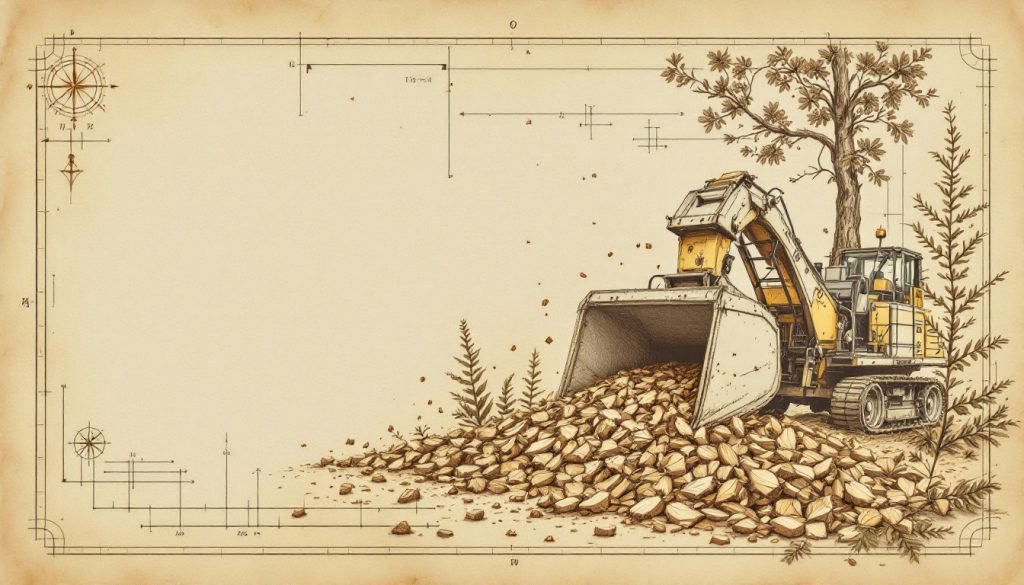
- Tritucap chip output quality varies by species, moisture content, and knife condition throughout the job. Fresh green chip piles exceed 140°F internally within 48 hours, creating fire risk above 10-foot pile heights. Diseased wood must never be chipped for on-site reuse — pathogens survive in fresh chip material. Knife clearance beyond 0.040 inches produces fibrous debris that clogs discharge chutes and degrades mulch value. Establish a written debris management protocol covering chip destination, disease exclusion, and pile limits before each job.
If you have recently watched a chipper crew work through a large removal job, you already know that the debris stream does not stop when the last branch feeds through the drum. The chips pile up fast, the discharge chute needs repositioning, and decisions about where that material goes have real consequences for the job site, the surrounding landscape, and the equipment itself. Tritucap chipping debris management refers to the systematic handling, routing, and disposal or reuse of wood chip output generated during tritucap-style chipping operations — a workflow that demands as much planning as the cutting work that precedes it.
I am Michael Hartman, ISA Board Certified Master Arborist (TX-0198B), and over three decades of field work I have watched debris management go from an afterthought to one of the most consequential variables in a tree care operation. Get it wrong and you are looking at clogged discharge systems, contaminated mulch loads, regulatory violations, or a crew spending the last two hours of a job moving chips by hand. Get it right and the debris stream becomes a resource — one that pays back in mulch value, soil amendment, and reduced hauling costs.
By the end of this article you will understand the mechanical principles behind tritucap chip output, how to plan a debris management strategy before the first branch goes in, how to evaluate chip quality for reuse, and what operational mistakes consistently derail otherwise well-run chipping jobs. Whether you are a property owner trying to understand what your tree service is doing or a crew leader looking to tighten up your workflow, this guide covers the full picture.
What Tritucap Chipping Actually Produces
The tritucap chipping process generates a heterogeneous output stream that varies significantly depending on species, moisture content, branch diameter, and knife condition. A healthy drum chipper running sharp knives through green hardwood will produce relatively uniform chips in the 1.5-3-inch range — ideal for landscape mulch or biomass applications. The same machine running dull knives through dry, punky wood produces a finer, dustier material with far less structural integrity and a higher likelihood of matting when applied to soil surfaces.
Wood species matters more than most operators acknowledge. Dense hardwoods like live oak (Quercus fusiformis) and pecan (Carya illinoinensis) produce chips with high lignin content that break down slowly — a benefit for long-term mulch applications but a consideration for composting timelines. Softer species like silver maple (Acer saccharinum) or cottonwood (Populus deltoides) chip into material that decomposes within a single growing season, making them better candidates for immediate soil incorporation than for surface mulch where longevity is valued.
Moisture content at the time of chipping also shapes the debris profile. Green wood chips retain cellular moisture and will heat significantly in a pile within 24 to 48 hours due to microbial activity. A chip pile from a full day’s work can reach internal temperatures exceeding 140°F within two days — hot enough to kill weed seeds and pathogens, but also hot enough to create spontaneous combustion risk if the pile exceeds roughly 12 feet in height and is not turned. Understanding what your chipper is producing is the foundation of every downstream debris decision.
Tritucap Chipping Debris: The wood chip, bark fragment, and fine particulate output generated by a tritucap-configured drum or disc chipper during tree removal or pruning operations, encompassing all material discharged from the chute regardless of particle size or species origin.
The Mechanical Logic Behind Chip Output and Discharge Control
Tritucap chipping systems are designed around a high-velocity discharge stream. The chute angle, deflector position, and truck or trailer positioning relative to the machine all determine where chips land and how uniformly they pile. A discharge chute set too steep concentrates chips in a tight cone directly behind the truck — fine for loading, problematic if the truck is not present and chips are landing on turf, hardscape, or a neighbor’s property. A chute set too flat spreads material over a wide arc, which can be useful for direct-to-ground mulching but creates cleanup time if the target area is not well defined in advance.
Chip velocity at the discharge point on a mid-size drum chipper typically ranges from 45 to 65 miles per hour. At that speed, even small bark fragments become projectiles. This is why ANSI Z133 standards require a minimum safe distance around the discharge zone and why crew positioning during active chipping is non-negotiable. Debris management planning must account for this ballistic reality — not just where chips end up at rest, but the arc they travel to get there.
Knife geometry and drum speed interact to determine chip thickness. A tritucap configuration running at standard drum RPM with properly set knife clearance (typically 0.020 to 0.030 inches) produces chips that are thin enough to dry quickly but thick enough to resist compaction. When knife clearance drifts beyond 0.040 inches — usually from wear or improper setting after sharpening — the machine begins tearing rather than cutting, producing stringy, fibrous material that clogs discharge chutes and creates bridging problems in the chip truck. Monitoring chip quality throughout the day is a direct diagnostic of knife condition.
Pro Tip: Pull a handful of chips from the discharge stream every two hours and look at the cut faces. Clean, flat chip faces mean your knives are sharp and your clearance is set correctly. Ragged, fibrous edges or excessive fines tell you the knives need attention before the next job — not after. Catching this mid-job saves you from a clogged chute and a load of unmarketable mulch.
Pre-Job Debris Management Planning
Effective tritucap land clearing debris management starts before the chipper engine turns over. The first question is destination: will chips be hauled off site, deposited on the property, or used for direct-to-ground mulching in place? Each answer drives a different setup. Hauling off site requires a chip truck positioned for efficient loading, which means evaluating driveway access, overhead clearance, and turnaround space before the crew arrives. Depositing on property requires a designated drop zone agreed upon with the property owner — ideally a location accessible by wheelbarrow or skid steer for redistribution.
Direct-to-ground mulching, sometimes called ramial chipped wood application, is increasingly popular with property owners who want to improve soil biology in planting beds or under tree canopies. For this application, chips should be applied at 4 to 6 inches depth and kept 3 to 4 inches away from trunk flare to prevent bark moisture accumulation and fungal issues. This method works best with mixed-species loads that include both wood and leaf material, as the leaf fraction accelerates microbial colonization of the chip layer.
Regulatory considerations belong in the pre-job planning conversation as well. Many municipalities have ordinances governing where wood chips can be deposited, particularly near waterways, storm drains, or public right-of-way. In Texas, for example, TCEQ guidelines address organic material placement near drainage features. A crew that dumps a full load of chips at the curb without checking local ordinances can generate a complaint that costs more in time and goodwill than the hauling fee would have.
Pre-Job Debris Management Checklist
- Confirm chip destination with property owner before work begins
- Assess driveway and access route for chip truck clearance and weight limits
- Identify any municipal or HOA restrictions on on-site chip deposits
- Designate a clear discharge zone with adequate buffer from structures and vehicles
- Check knife condition and drum clearance before first feed
- Confirm chip truck or trailer capacity relative to estimated job volume
Evaluating Chip Quality for Reuse and Marketability
Not all chip loads are equal, and the difference between a marketable mulch product and a load destined for the landfill often comes down to what went through the chipper. Diseased wood is the most significant quality concern. Material from trees infected with oak wilt (Bretziella fagacearum), laurel wilt, or Dutch elm disease should never be chipped for reuse on the same property or distributed as mulch. The fungal mats and beetle vectors associated with these pathogens can survive in fresh chip material long enough to infect nearby susceptible hosts. Chips from diseased trees should be buried, burned where permitted, or hauled to a facility that processes material at sustained high temperatures.
Treated wood — including utility poles, railroad ties, or any lumber that may have entered the brush pile — contaminates the entire chip load for landscape use. Chromated copper arsenate (CCA) and other preservative treatments render chips unsuitable for residential mulch applications. Training crews to identify and reject treated material before it enters the feed chute is a quality control step that protects both the end user and the company’s reputation.
For operations that sell or donate chip loads, a simple visual grading system helps maintain consistency. Grade A chips come from green, disease-free mixed wood and leaf material, run through sharp knives, and are free of soil contamination. Grade B chips may include some dry or punky wood but are still suitable for pathway mulch or erosion control applications. Any load containing treated wood, diseased material, or significant soil contamination should be classified as non-reusable and disposed of accordingly.
On-Site Chip Pile Management and Safety
When chips are staged on site — whether awaiting redistribution or pickup — pile geometry and monitoring matter. As noted earlier, fresh green chip piles generate significant internal heat through microbial respiration. A pile that is allowed to grow beyond 10 to 12 feet in height without turning becomes a fire risk, particularly in dry conditions. Best practice is to limit pile height to 8 feet, turn the pile if it will sit for more than 72 hours, and never stage a chip pile against a structure, fence, or vehicle.
Chip piles on slopes present a different hazard. Even a modest 3-to-1 slope can allow a large chip pile to slump or flow after rain, particularly if the chips are fine-textured and wet. Positioning piles on flat ground or using temporary containment — even a simple ring of larger logs — prevents material migration onto driveways, sidewalks, or neighboring properties.
For jobs where chips are being applied directly as mulch under tree canopies, the application depth deserves attention. Research from the International Society of Arboriculture supports mulch depths of 2 to 4 inches for most landscape applications, with deeper applications reserved for restoration plantings where weed suppression is the primary goal. Piling chips against the trunk — what arborists call volcano mulching — is one of the most common and damaging practices in residential landscaping, creating chronic bark moisture conditions that invite fungal decay and secondary pest pressure.
Common Debris Management Mistakes to Avoid
- Chipping diseased wood for on-site reuse: Fungal pathogens and insect vectors can survive in fresh chips; always haul diseased material off site to a high-temperature composting facility.
- Ignoring chip pile height limits: Piles exceeding 10 feet generate dangerous internal heat and present spontaneous combustion risk within 48 to 72 hours in warm weather.
- Volcano mulching around trunk bases: Chips piled against bark trap moisture, promote fungal decay, and invite secondary pest colonization — keep mulch 3 to 4 inches clear of the trunk flare.
- Running dull knives without monitoring chip quality: Fibrous, stringy output signals knife wear that will clog discharge systems and degrade mulch quality; check chip faces every two hours.
Equipment Maintenance Tied to Debris Quality
The condition of the chipping equipment is inseparable from the quality of the debris it produces. Tritucap drum chippers rely on precisely set knife clearances, balanced knife weights, and a clean anvil surface to produce consistent chip geometry. When one knife in a multi-knife drum wears faster than the others — common when operators feed material unevenly or allow rocks and soil to enter the feed chute — the resulting imbalance creates vibration that accelerates bearing wear and produces inconsistent chip size across the discharge stream.
Discharge chute maintenance is equally important. Chip buildup on the interior walls of the chute reduces velocity and creates bridging points where wet or fibrous material can accumulate and eventually block the discharge entirely. A blocked discharge chute on a running chipper is a serious safety event. Chutes should be inspected and cleared at every fuel stop, and any buildup of resinous material — common when chipping pine or cedar — should be addressed with a scraper before it hardens.
The chip truck or trailer is the final link in the debris management chain. Overloading a chip truck compresses the load, increases the difficulty of unloading, and can exceed vehicle weight ratings on residential streets. A standard 10-yard chip body holds roughly 3,000 to 4,000 pounds of green hardwood chips — a figure that climbs quickly on a full-day removal job. Knowing your truck’s rated capacity and monitoring load weight prevents both equipment damage and road damage liability.
What to Do Next: Building a Debris Management Protocol
Whether you are managing a single-crew operation or overseeing a multi-truck tree service, the payoff from a written debris management protocol is immediate. Start by documenting your chip destination decision tree: who asks the property owner, when, and what the default answer is if no preference is stated. Add your knife inspection schedule, your pile height limits, and your disease exclusion criteria. This does not need to be a lengthy document — a single laminated card in each truck cab covers the essentials and gives new crew members a clear reference point.
For property owners, the most actionable takeaway is to have the debris conversation with your tree service before work begins, not after. Ask where the chips will go, whether any of the material is from diseased trees, and whether on-site mulching is an option. A company that has clear answers to those questions has thought through its debris management process. One that seems surprised by the questions probably has not.
Tritucap chipping debris management is not glamorous work, but it is where the quality of a tree care operation becomes visible. Sharp knives, planned chip destinations, proper pile management, and disease-aware material handling are the markers of a professional crew. They are also the factors that determine whether the debris stream from your next removal job becomes a liability or a resource.