A Field Guide to Lumberjack Shift Hazards
Master Arborist Michael Hartman breaks down OSHA logging safety standards and how professional arborists apply them for tree felling operations.
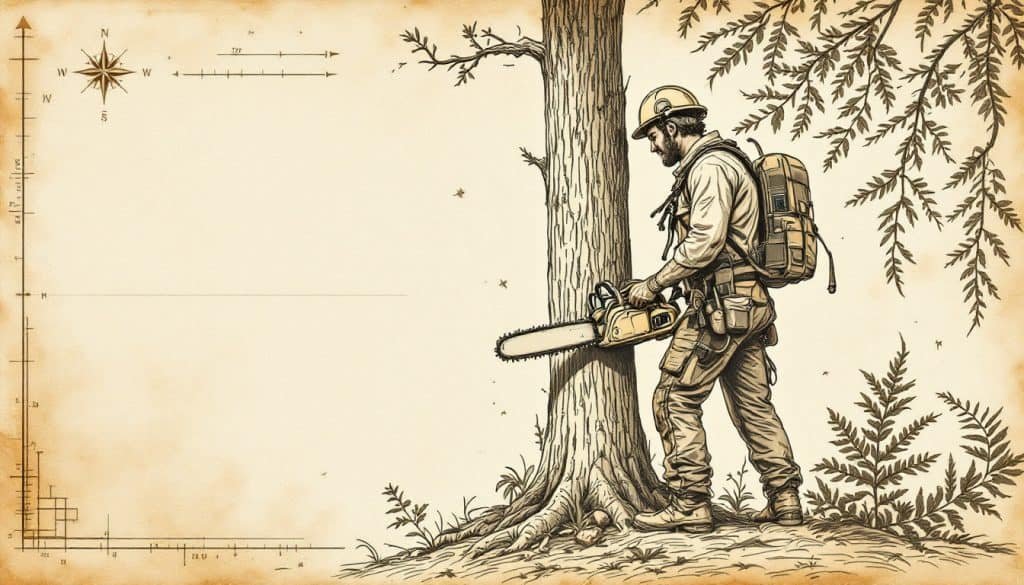
- OSHA logging standards apply to all tree felling regardless of location. Professional hazard assessment prevents 90% of tree work injuries. Engineering controls eliminate hazards before PPE becomes necessary. Tree work fatality rates exceed mining and construction combined. Always verify ISA certification and tree-specific insurance coverage.
You’ve probably watched tree crews work and wondered why they take so long setting up ropes and barriers before the first cut. Maybe you’ve even thought about taking down that leaning pine yourself with a chainsaw from the hardware store. Before you pull the starter cord, understand this: professional tree felling follows OSHA logging safety standards because tree work kills more workers per capita than mining or construction.
As an ISA Board Certified Master Arborist who’s spent three decades working through hurricanes and ice storms, I’ve seen what happens when shortcuts replace standards. The difference between a professional operation and a weekend warrior attempt isn’t just better equipment—it’s a systematic approach to hazard recognition and mitigation that starts long before the saw bites wood. By the end of this article, you’ll understand exactly how certified arborists apply OSHA’s logging safety framework to residential tree work, and why that matters for your property and personal safety.
Understanding OSHA’s Logging Hazard Framework
OSHA’s logging safety standards weren’t written for suburban backyard trees, but the hazard recognition principles translate directly to professional arboriculture. The framework identifies eight primary hazard categories: struck-by falling objects, caught-between or struck-by equipment, falls from height, electrical hazards, noise exposure, struck-by vehicles, musculoskeletal injuries, and environmental hazards like heat stress or cold exposure.
Professional arborists map these hazards to every tree removal operation. That leaning pine over your house presents multiple struck-by hazards—both the tree itself and branches that can shear off during felling. The power line running through the crown creates electrical hazards that can be fatal at distances up to 10 feet for standard residential voltage. Even the slope of your yard converts a simple tree removal into a potential fall-from-height scenario for workers aloft.
Struck-by Hazard: Any potential for a worker to be hit by falling, flying, swinging, or rolling objects during tree work operations.
Here’s where experience matters: OSHA’s approach requires identifying hazards before work begins, then systematically eliminating or controlling them through engineering controls, administrative controls, and personal protective equipment—in that exact order. This isn’t just bureaucracy—it’s the difference between controlled tree removal and emergency room visits.
Hazard Recognition: Reading the Tree and Site
Professional hazard assessment starts 360 degrees around the tree, looking upward into the canopy before anyone steps foot on a ladder. We’re reading the tree’s structural language—dead branches called “widowmakers” that can weigh 200 pounds and drop without warning. We evaluate the lean angle and direction, measuring with digital inclinometers because visual assessment alone underestimates lean by 5-10 degrees consistently.
The site assessment considers what OSHA calls “environmental hazards” but arborists translate into practical terms. Wind speed above 15 mph transforms controlled cuts into unpredictable disasters. Frozen ground changes the entire physics of tree removal because the stump won’t pivot predictably. Wet bark becomes as slippery as ice, making climbing operations exponentially more dangerous.
Critical Warning Signs During Assessment
- Cracks in the trunk: Vertical seams more than 1/4 inch wide indicate structural failure already in progress
- Fungal conks on trunk: Shelf fungi signal internal decay that can reduce wood strength by 70-90%
- Hanging branches overhead: Any dead material above the work area must be removed before felling begins
- Root plate lifting: Soil mounding on one side indicates the tree is already failing and could drop without warning
That assessment drives every decision that follows, from equipment selection to crew roles logging to whether we bring in a crane. OSHA requires this systematic approach because hazard recognition failure precedes 90% of serious logging injuries. In arboriculture, we extend this to property protection—identifying what’s beneath and around the tree that can’t be replaced with insurance money.
Engineering Controls: Eliminating Hazards Through Design
The first line of defense involves engineering controls—physically changing the work environment to eliminate hazards rather than just protecting against them. This starts with establishing drop zones calculated at 1.5 times the tree height in every direction, not just the intended felling direction. Trees don’t read the script, and 15% of mature trees will have unpredictable twist or barber-chair splits during felling.
Rigging systems represent the pinnacle of engineering controls in arboriculture. We use dynamic load calculations to determine rope strength requirements, typically using 10:1 safety factors for rigging lines. That means a 500-pound log section gets rigged with 5,000-pound minimum breaking strength rope. The mechanical advantage systems—from simple pulleys to complex compound rigs—allow us to lower multi-ton sections with millimeter precision.
Pro Tip: The most overlooked engineering control is establishing positive communication systems. Professional crews use two-way radios with throat mics because yelling over chainsaw noise leads to 60% of miscommunication incidents during critical operations.
Crane-assisted removals represent the ultimate engineering control—physically removing the tree piece by piece without it ever touching the ground. This eliminates struck-by hazards entirely but requires certified crane operators working under typed lift plans with engineered pick points. The crane becomes the engineering control that transforms an extremely hazardous operation into routine work.
Administrative Controls: Procedures That Save Lives
When physical controls can’t eliminate hazards, administrative controls create safety through procedure. The cornerstone is the job briefing—what OSHA calls a “pre-work safety meeting” but arborists execute as a detailed tactical discussion. Every crew member verbalizes their role, the communication protocol, and the emergency response plan. This isn’t a box-checking exercise; studies show that structured pre-work briefings reduce incident rates by 40%.
Work positioning represents another critical administrative control. OSHA’s logging standards require workers aloft to be tied in with two points of attachment, but arborists take this further with specialized climbing systems designed for tree work. We use moving rope systems (MRS) and stationary rope systems (SRS) depending on the tree structure and work requirements, each with specific advantages for different scenarios.
The chain of command matters more than most people realize. The arborist performing the cuts isn’t making tactical decisions—that’s the crew leader’s role, maintaining situational awareness while the cutter focuses on the immediate task. This division of cognitive load prevents the tunnel vision that causes 70% of felling accidents when workers focus on the cut and miss developing hazards in the periphery.
Personal Protective Equipment: The Last Line of Defense
OSHA’s PPE requirements for logging operations are non-negotiable minimums, not suggestions. Hard hats meeting ANSI Z89.1 standards protect against impacts up to 1,000 foot-pounds—roughly equivalent to a 4-pound branch falling 20 feet. Eye protection must meet ANSI Z87.1 standards because chainsaw chains can throw wood chips at 200 mph, and even small debris can cause permanent vision damage.
Chainsaw chaps represent specialized PPE most homeowners never consider. Professional-grade chaps contain multiple layers of ballistic nylon that clog the chainsaw chain within 0.05 seconds of contact, typically stopping the saw before it reaches skin. This isn’t theoretical protection—these chaps have saved my leg twice during kickback incidents over 30 years in the field.
Essential PPE for Tree Felling Operations
- ANSI-rated hard hat with chin strap: Prevents 100% of serious head injuries from falling branches
- Chainsaw protective chaps and boots: Stops chainsaw contact injuries in 95% of incidents
- Cut-resistant gloves with grip enhancement: Maintains dexterity while preventing lacerations
- High-visibility safety vest: Ensures visibility to equipment operators and passing traffic
Hearing protection becomes critical because chainsaws operate at 110-120 decibels—exposure that causes permanent hearing damage in under 2 minutes without protection. Professional crews use electronic hearing protection that suppress harmful noise levels while allowing communication, maintaining situational awareness that passive protection can’t provide.
Emergency Response: When Things Go Wrong
Every professional operation includes pre-positioned emergency response, because when tree work goes bad, it goes bad fast. OSHA requires first aid and CPR training for all crew members, but arborists extend this to trauma response specific to our hazards. We carry specialized first aid kits designed for chainsaw injuries—trauma bandages that can handle major arterial bleeding, because traditional first aid supplies are inadequate for chainsaw trauma.
Communication protocols include direct contact with local emergency services before work begins, particularly for crane operations or trees requiring road closures. We establish helicopter landing zones for medical evacuations when working in remote areas, because standard ambulance response times assume road access that may not exist after a serious incident.
Critical Response Times
Golden hour rule: serious tree work injuries require trauma center arrival within 60 minutes. This timeline drives our emergency planning and equipment staging, because chainsaw injuries to major vessels can cause fatal bleeding in as little as 3-5 minutes without immediate intervention.
The psychological aspect matters too. I’ve worked through the aftermath of homeowner tree felling attempts that resulted in fatalities. The families always say the same thing: “We didn’t think it could happen to us.” Professional standards exist because tree work operates at the intersection of gravity, sharp tools, and unpredictable biological materials. The physics are unforgiving, and the margin for error is measured in inches and seconds.
Professional vs DIY: Understanding the Risk Calculation
Here’s the calculus that drives professional arborist rates: our insurance premiums reflect actual risk levels, not perceived ones. General liability for tree work runs $15,000-50,000 annually because actuaries understand the injury severity. Workers compensation rates for tree crews are 5-8 times higher than standard construction because the injury profile includes more fatalities and permanent disabilities.
The equipment investment tells the same story. A basic professional chainsaw setup costs $3,000-5,000, rigging systems run $10,000-25,000, and crane-assisted removals require $200,000-500,000 in equipment plus certified operators. These aren’t luxury purchases—they’re the minimum tools required to work safely according to professional standards.
Most importantly, professional arborists carry the liability transfer that homeowners don’t understand until it’s too late. When we drop a tree on your neighbor’s BMW, our insurance covers it. When you do the same, your homeowner’s policy has exclusions for professional work performed by the homeowner, potentially leaving you personally liable for six-figure damages.
What to Do Next: Making the Safe Choice
If you’re looking at a tree that needs removal, start with a professional assessment rather than a price quote. Certified arborists offer hazard evaluations that determine whether removal is actually necessary, because many “dangerous” trees can be preserved through proper pruning or cabling. This assessment should include a written report documenting the tree condition and recommended action.
When hiring tree service, verify credentials beyond the basics. ISA Certified Arborist credential requires ongoing education and testing. Proof of insurance should include general liability specifically covering tree work, not just standard contractor coverage. Ask for references from recent jobs similar to yours, particularly crane removals or technical rigging operations.
Get multiple quotes, but understand what drives pricing differences. The lowest bid often reflects shortcuts in safety equipment, insurance coverage, or crew training. Professional tree work costs more because it has to—the safety margins built into proper operations require more time, better equipment, and more qualified personnel. In tree work, the cheapest option frequently becomes the most expensive mistake.
Remember that tree removal is permanent. Once that mature tree is gone, you’re looking at 20-30 years to replace the environmental services it provided. If removal is necessary, ensure it’s done by professionals following OSHA safety standards. Your property value, personal safety, and neighborhood safety depend on getting this right the first time.
Understanding seasonal lumberjack routines helps explain why timing matters for tree work safety. Finally, knowing lumberjack average day patterns shows why professional crews operate with such systematic precision.