Winch Tensioning Procedure: What Property Owners Should Know
Learn how proper winch tensioning procedure controls tree felling direction and prevents dangerous kickback during hand-felling operations.
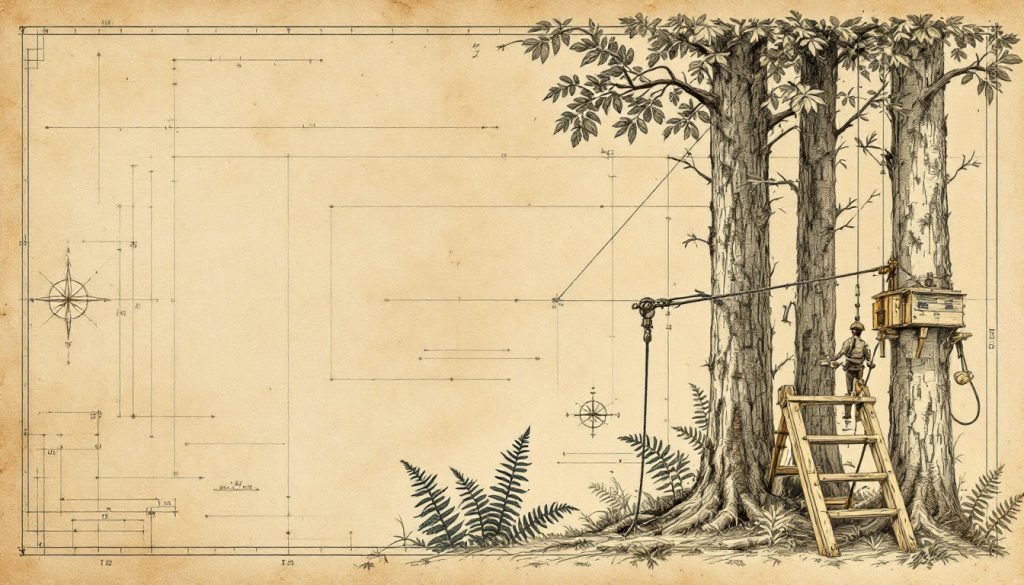
- Winch tension must be pre-loaded before any cuts begin, not applied reactively mid-operation. Attach the pulling sling at two-thirds to three-quarters of tree height for maximum mechanical advantage. The winch operator must maintain or increase tension throughout the back cut as hinge wood thins. Trees over 30 inches DBH or with lean exceeding 15 degrees typically require aerial rigging or crane dismantling. Ask any contractor to explain their winch tensioning procedure before work starts — vague answers are a red flag.
You have a large tree that needs to come down, and the lean is wrong. Maybe it tilts toward the house, toward a fence line, or over a neighbor’s property. A chainsaw alone cannot overcome physics — a tree leaning 15 degrees toward a structure will fall toward that structure unless something actively pulls it in the opposite direction. That something is a properly tensioned winch system, and the procedure for setting it up correctly is one of the most misunderstood steps in hand-felling operations.
The winch tensioning procedure is the sequence of steps used to pre-load a mechanical or hydraulic pulling device against a tree before the felling cuts are made, so that controlled tension guides the fall along a predetermined path. Get it right and you have a predictable, safe felling operation. Get it wrong — too little tension, wrong anchor angle, or tension applied at the wrong moment — and the winch becomes a false sense of security rather than a genuine safety system. I’m Michael Hartman, ISA Board Certified Master Arborist (TX-0198B), and I’ve used winch systems on hundreds of felling jobs across Texas and the Gulf Coast region. This article walks you through what the procedure actually involves, why each step matters, and what warning signs should prompt you to call a professional instead of proceeding on your own.
By the end, you will understand the mechanical principles behind winch tensioning, the correct sequence of operations, the most dangerous mistakes made in the field, and how to evaluate whether a given tree and site are appropriate for a winch-assisted hand-fell versus a more complex rigging operation.
Why Winch Tension Controls Felling Direction
A felling winch works on a simple mechanical principle: it applies a horizontal pulling force to the trunk above the hinge, counteracting the tree’s natural lean or weight distribution. The hinge — the uncut wood fiber left between the face notch and the back cut — acts as a pivot point. When tension is correctly applied before the back cut is completed, the winch load transfers through the hinge and steers the fall. Without pre-loaded tension, the hinge alone must resist the tree’s momentum, and on a back-leaning or side-leaning tree, that is often not enough.
The physics become clearer when you think about the center of gravity. A 24-inch DBH (diameter at breast height) white oak standing 70 feet tall carries an enormous amount of mass well above the cut zone. Even a modest lean of 5 to 8 degrees shifts that center of gravity significantly off the stump centerline. A 1.5-ton pulling capacity winch anchored at a 45-degree upward angle to the trunk can generate enough horizontal force to overcome that lean — but only if the tension is set before the back cut severs the hinge. Applying tension after the hinge breaks is too late. The tree is already in motion, and no winch rated for field use will arrest a falling tree mid-descent.
Hinge Wood: The uncut band of wood fiber left between the face notch and the back cut during tree felling. The hinge controls the direction and speed of the fall by acting as a pivot; its width and thickness must be proportional to trunk diameter to function correctly.
This is why the tensioning procedure is a pre-cut operation, not a reactive one. The winch must be loaded to working tension — typically 10 to 20 percent of its rated capacity for a straight-standing tree, and up to 50 percent or more for a significant back lean — before the saw operator begins the back cut. That pre-load keeps the hinge under consistent directional stress throughout the cut sequence.
Equipment Required for a Proper Winch Tensioning Setup
The winch tensioning procedure is only as reliable as the equipment used to execute it. A come-along hand winch rated at 2 tons is adequate for trees up to roughly 18 inches DBH with moderate lean. For larger trees or significant back lean, a 3- to 5-ton mechanical winch or a dedicated felling winch such as the Tirfor T-35 or equivalent is more appropriate. These tools use a reciprocating jaw mechanism that grips the wire rope or pulling strap on both the forward and return strokes, allowing continuous tension buildup without slack.
Tools You Will Need
- Mechanical felling winch (2–5 ton rated): Select capacity based on tree DBH and lean severity; Tirfor-style wire rope winches offer the most consistent tension control
- Wire rope or synthetic pulling strap: Wire rope (3/8-inch minimum) for heavy loads; synthetic high-strength strap for lighter pulls where stretch is acceptable
- Anchor sling and shackle: A rated tree-saver sling (minimum 2-inch width) protects the anchor tree bark and distributes load; never wrap bare wire rope around a live anchor tree
- Attachment sling for felling tree: Positioned 2/3 to 3/4 of tree height for maximum mechanical advantage; rated for the expected load
- Snatch block (optional): Used to redirect the pull angle when a direct anchor is not available in the desired felling direction
- Load indicator or tension gauge: Allows the operator to confirm working tension before beginning cuts
The anchor point deserves particular attention. The anchor tree must be healthy, well-rooted, and at least 12 inches DBH — larger is better. A compromised anchor tree that fails mid-operation releases all stored tension instantly, which can cause the felling tree to snap back or fall unpredictably. Always inspect the anchor tree for decay, root damage, and structural defects before rigging to it.
The Winch Tensioning Procedure Step by Step
The procedure follows a deliberate sequence. Skipping steps or reordering them introduces risk at every stage. Before any equipment is attached, the felling zone must be cleared of personnel and debris, escape routes must be established (typically two routes at 45-degree angles behind and away from the intended fall direction), and the saw operator and winch operator must agree on communication signals.
First, attach the pulling sling to the felling tree at a height equal to two-thirds to three-quarters of the total tree height. Higher attachment increases mechanical advantage but also increases the risk of the sling sliding or the tree snapping above the attachment point under extreme load. For a 60-foot tree, an attachment height of 40 to 45 feet is appropriate. Use a rated climbing sling and a locking carabiner or shackle — never a simple slip knot in a rope.
Second, run the wire rope or strap from the felling tree attachment point to the anchor, keeping the line as close to horizontal as the site allows. A steep upward angle reduces the effective horizontal pulling force. A line angled 30 degrees above horizontal loses roughly 13 percent of its horizontal pulling component compared to a level pull. Third, connect the winch to the anchor sling using a rated shackle, and take up all slack in the system. Fourth, apply initial tension — enough to remove all sag from the line but not yet working load. Inspect every connection point at this stage before proceeding.
Pre-Cut Winch Tension Verification Checklist
- All sling and shackle connections are rated, locked, and visually inspected
- Wire rope or strap shows no kinks, fraying, or damage along its full length
- Anchor tree is healthy, minimum 12 inches DBH, with no visible decay or root heave
- Winch is loaded to working tension and operator confirms load on gauge or by line feel
- Felling tree attachment sling is positioned at 2/3 to 3/4 of tree height and is not slipping
- Saw operator and winch operator have confirmed communication signals
- Escape routes are clear and all non-essential personnel are outside the felling zone
Fifth, increase tension to working load. For a tree with no significant lean, this is a moderate pre-load — enough that the line is taut and vibrates when struck, but not so high that the anchor tree is visibly stressed. For a back-leaning tree, working tension must be sufficient to begin moving the tree’s center of gravity toward the intended fall direction before the back cut is started. The saw operator should not begin the face notch until the winch operator confirms working tension is achieved and stable.
Coordinating the Winch Operator and Saw Operator
The winch tensioning procedure is a two-person minimum operation, and the coordination between the winch operator and the saw operator is where many field failures occur. These two roles must be in constant communication throughout the cut sequence. The standard protocol used by most professional crews is a verbal or radio-based call-and-confirm system: the saw operator calls out each phase of the cut, and the winch operator confirms tension status before the next phase begins.
During the back cut, the winch operator’s job is to maintain or increase tension as the hinge thins. As wood fiber is removed, the tree’s resistance to the winch decreases, and the operator must take up any slack that develops. Allowing the line to go slack during the back cut defeats the entire purpose of the pre-load — the hinge loses its directional guidance and the fall becomes unpredictable. The winch operator should be positioned well to the side of the tension line, never directly behind the anchor or in line with the wire rope. A snapped wire rope under load is a lethal projectile.
Pro Tip: On back-leaning trees, I always make a shallow relief cut on the back of the trunk — about 1 inch deep, 2 inches above the intended back cut line — before applying full winch tension. This relieves compression stress in the back wood and prevents the saw from being pinched during the back cut. It’s a small step that takes 30 seconds and has saved me from a pinched bar more times than I can count.
Once the hinge releases and the tree begins to fall, the winch operator steps clear of the tension line and does not attempt to control the fall further. The winch has done its job. Trying to maintain tension on a falling tree risks pulling the anchor tree, snapping the line, or dragging equipment into the fall zone.
Common Mistakes That Compromise the Procedure
The most frequent error in winch tensioning is applying tension too late — after the face notch is cut but before the back cut, rather than before any cuts are made. While tension applied between the notch and back cut is better than no tension, it misses the opportunity to pre-load the hinge wood during the most stable phase of the operation. The correct sequence is: site prep, anchor rigging, tension to working load, then begin face notch.
Common Mistakes to Avoid
- Insufficient attachment height: Attaching the pulling sling too low on the trunk reduces mechanical advantage dramatically — a sling at 20 feet on a 60-foot tree provides far less leverage than one at 40 feet, and may not overcome even moderate back lean
- Undersized anchor tree: Using a small or compromised anchor tree risks anchor failure mid-operation, releasing stored tension suddenly and unpredictably
- Slack line during back cut: Allowing the wire rope to go slack as the hinge thins removes directional control at the most critical moment of the fell
- Standing in line with the tension: Positioning personnel directly behind the anchor or along the wire rope path puts them in the projectile zone if any component fails under load
- Exceeding winch rated capacity: Overloading a come-along or felling winch can cause catastrophic mechanical failure; when in doubt, use a higher-rated tool or bring in a crane service
When the Winch Tensioning Procedure Is Not Enough
A ground-based winch tensioning setup has real limits. Trees with severe back lean — more than 10 to 15 degrees — may require tension loads that exceed what a standard felling winch can safely generate from a ground anchor. Very large trees, typically above 30 inches DBH, accumulate so much mass that the mechanical advantage available from a ground-level pull is insufficient to reliably overcome the lean. In these cases, the appropriate response is not a bigger winch — it is a different method entirely.
Aerial rigging, where a climber installs a high-lead block near the crown and redirects the pull vector through a more favorable angle, can dramatically increase effective tension on large trees. Alternatively, sectional dismantling with crane-assisted lowering eliminates the felling direction problem altogether by removing the tree in pieces rather than as a whole stem. Property owners should understand that the winch tensioning procedure is a tool for manageable hand-felling scenarios, not a universal solution for every difficult tree.
What Property Owners Should Do Before Any Felling Operation
If you are a property owner evaluating whether a winch-assisted hand-fell is appropriate for a tree on your property, the first step is an honest assessment of the tree’s size, lean, and proximity to structures. A tree under 18 inches DBH, with a lean of less than 10 degrees toward a clear felling zone, and with a suitable anchor tree available in the intended fall direction, is a reasonable candidate for a winch-assisted hand-fell by a qualified arborist crew. Anything outside those parameters warrants a more detailed site assessment.
Request that any contractor performing the work walk you through their winch tensioning procedure before work begins. Ask where the attachment point will be on the felling tree, what the anchor tree is, what the winch capacity is, and how the saw operator and winch operator will communicate during the back cut. A professional crew should answer these questions without hesitation. Vague answers or a crew that plans to fell without any tensioning system on a back-leaning tree are both red flags worth taking seriously. The winch tensioning procedure is not optional equipment on a difficult fell — it is the difference between a controlled operation and an uncontrolled one.
For additional safety guidance, see this homeowner checklist on tree removal best practices.