Understanding Felling Pull Direction Calculation
Learn how arborists calculate felling pull direction to control where a tree falls safely and precisely every time.
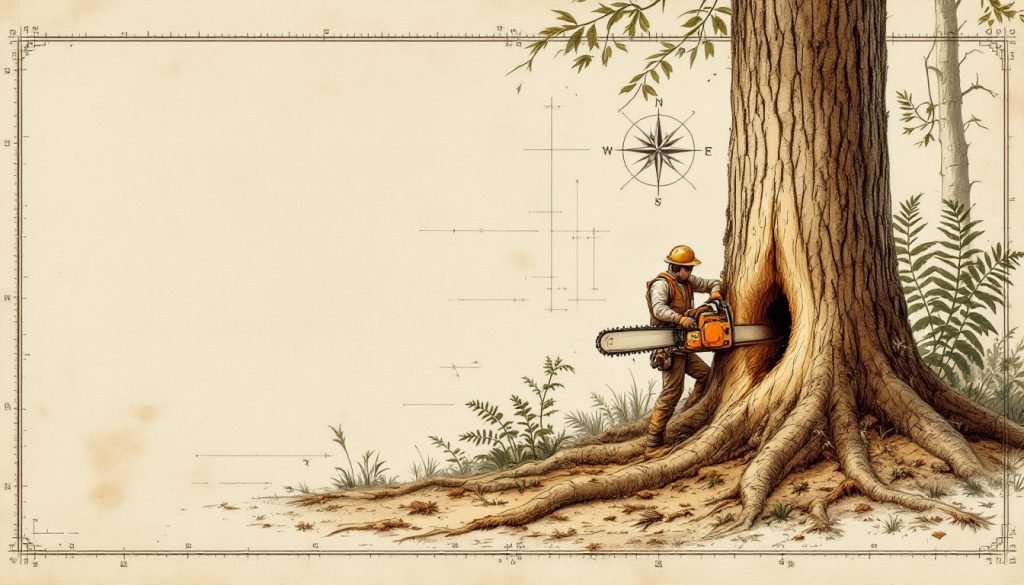
- Felling pull direction is determined by the net vector of stem lean, crown mass distribution, and wind load acting on the tree's center of gravity. Notch face bearing must align with the intended landing zone within 5 degrees — errors translate directly into off-target falls. Hinge thickness at 10 percent of stem diameter gives directional control; deviating from this causes uncontrolled or split falls. Mechanical pulling lines must anchor in the exact intended fall direction, not just away from hazards, or the calculation fails. Trees with back-lean over 5 degrees, DBH over 24 inches, or significant decay require a certified arborist for safe pull direction work.
You are standing at the base of a 60-foot white oak, chainsaw in hand, and the tree needs to come down. The house is 40 feet to the northeast, a fence runs along the south property line, and the only clear landing zone is a narrow corridor to the northwest. Getting the tree into that corridor is not a matter of luck — it is a matter of felling pull direction calculation, and every cut you make either supports or undermines that calculation. This is the skill that separates a controlled fell from a catastrophic one.
Felling pull direction calculation is the process of analyzing all forces acting on a standing tree — lean, crown weight distribution, wind load, root plate integrity, and hinge geometry — and then determining the precise direction the tree will travel when the hinge releases. It also includes the techniques used to redirect or reinforce that direction when natural forces do not align with the intended landing zone. Michael Hartman, ISA Board Certified Master Arborist (TX-0198B), has applied these principles across thousands of removals in Texas and surrounding regions, where leaning post oaks, wind-loaded pecans, and structurally compromised elms demand accurate pull direction work on nearly every job.
By the end of this article, you will understand the mechanical forces that govern a felling pull direction calculation, how to read a tree’s natural lean and crown bias, how to use notch geometry and back-cut placement to steer the fall, and when mechanical assistance is necessary to override natural forces entirely.
The Physics Behind Felling Pull Direction
Every standing tree is a lever balanced on a root plate. When you cut through the stem, you are removing the structural support that keeps that lever upright. The direction the tree falls is determined by the net vector of all forces acting on the center of mass at the moment the hinge fails. Understanding this is the foundation of any accurate felling pull direction calculation.
Gravity acts straight down through the tree’s center of mass. If a tree has a pronounced lean, the center of mass is offset from the root plate, and gravity creates a moment arm that pulls the tree in the direction of that lean. A tree with a 5-degree lean toward the northeast will have a strong natural pull to the northeast that must be either used or overcome. Crown asymmetry adds another variable — a tree with 70 percent of its crown mass on the west side will pull west regardless of stem lean. Wind load at the time of felling can add or subtract from these vectors, which is why felling in winds above 10 mph is generally inadvisable for precision work.
The hinge — the uncut wood fiber left between the notch and the back cut — acts as a pivot point and a steering mechanism. Its width, thickness, and lateral position relative to the stem center all influence the pull direction. A hinge that is thicker on the left side will cause the tree to rotate slightly right as it falls. This is not a flaw; it is a tool. Experienced fallers intentionally bias hinge thickness to fine-tune pull direction by 5 to 15 degrees in either direction.
Hinge: The uncut band of wood fiber left between the face notch and the back cut during a fell. It controls the direction and speed of the tree’s fall by acting as a pivot and brake.
Reading Natural Lean and Crown Weight Distribution
Before any calculation begins, you need an accurate read of where the tree wants to go. Natural lean is the most obvious factor, but it is frequently misread because observers stand too close to the base. Step back at least two tree-lengths and sight the stem against a vertical reference — a plumb line, a door frame, or a level held at arm’s length. Do this from two perpendicular angles to identify both the magnitude and the true compass direction of the lean. A tree that appears to lean north from the south may actually lean northwest when viewed from the east.
Crown weight distribution requires a different assessment. Look up into the canopy and estimate where the bulk of the live crown mass sits. In species like silver maple and cottonwood, crown asymmetry is common due to competition, storm damage, or proximity to structures. A 20-foot crown overhang on one side can exert enough moment force to override a modest stem lean in the opposite direction. For large trees, some arborists use a simple plumb bob hung from a high branch to locate the crown’s approximate center of gravity relative to the root plate.
Root plate condition also matters. A tree with significant root decay on the north side has reduced resistance to northward pull, meaning the tree may fall north faster and with less control than the stem lean alone would suggest. Probe the root flare with a mallet and a thin rod to identify soft zones before finalizing your pull direction calculation.
Pro Tip: On leaning trees, I always verify lean direction with a plumb bob hung from a branch stub at mid-crown height, then drop a second plumb from the stem base. The horizontal offset between the two tells me the true lean vector more reliably than eyeballing the stem from the ground — especially on curved or buttressed trunks where the base lean and upper lean differ.
Notch Geometry and Its Role in Directing the Fall
The face notch — also called the directional notch or humboldt notch depending on configuration — is the primary steering mechanism in felling pull direction calculation. The notch opening faces the intended direction of fall, and the notch apex defines the hinge line. The compass bearing of the notch face must align precisely with the intended landing zone, not just approximately. A 10-degree error in notch orientation translates directly into a 10-degree error in fall direction, which at 60 feet of tree height means the tip lands 10 feet off target.
The conventional open-face notch uses a top cut angled downward at 60 to 70 degrees and a bottom cut angled upward at 20 to 30 degrees, meeting at the apex. This geometry allows the tree to fall through a wider arc before the notch closes, giving the faller more time to retreat. The traditional Humboldt notch uses a flat bottom cut and a downward-angled top cut, which is efficient on large-diameter timber but closes faster. For precision pull direction work in tight landing zones, the open-face notch is the preferred configuration because the wider closing arc reduces the risk of the tree kicking back or splitting the hinge prematurely.
Notch depth should be approximately one-quarter to one-third of the stem diameter. Cutting deeper than one-third reduces the available hinge wood and compromises directional control. On a 24-inch diameter tree, that means a notch depth of 6 to 8 inches. Cutting shallower than one-quarter leaves too much wood ahead of the hinge line and can cause the tree to stall or split unpredictably.
Back Cut Placement and Hinge Engineering
The back cut is where felling pull direction calculation becomes precise engineering. The back cut is made from the opposite side of the stem, slightly above the notch apex, and it creates the hinge by leaving a band of uncut fiber connecting the notch face to the back of the tree. The thickness of this hinge band — typically 10 percent of the stem diameter, or about 2.4 inches on a 24-inch tree — determines how much control you retain over the fall.
Hinge width spans the full diameter of the stem perpendicular to the fall direction. To steer the tree slightly left of the notch bearing, you cut the back cut so that the hinge is slightly thicker on the right side. The thicker side acts as a brake and pivot, causing the tree to rotate toward the thinner side as it falls. This technique allows pull direction adjustments of roughly 5 to 15 degrees without repositioning the notch. Beyond 15 degrees of correction, the hinge geometry becomes unreliable and mechanical assistance is the safer option.
The back cut must remain above the notch apex throughout its length. If the back cut drops below the apex on either side, the hinge loses integrity and the tree can barber-chair — splitting vertically up the stem — which is one of the most dangerous failures in hand felling. On trees with significant back-lean against the intended fall direction, a bore cut technique allows the faller to establish the hinge before the back cut reaches the tension wood, reducing barber-chair risk substantially.
Common Mistakes to Avoid
- Misreading lean direction: Assessing lean only from one angle leads to errors of 20 degrees or more in pull direction. Always verify from two perpendicular sightlines before cutting.
- Undersized hinge: Cutting the back cut too close to the notch apex leaves insufficient hinge wood, causing the tree to fall uncontrolled or split. Maintain hinge thickness at 10 percent of stem diameter.
- Ignoring crown asymmetry: Calculating pull direction from stem lean alone without accounting for crown weight distribution is a common cause of trees falling off-target, especially in open-grown specimens with wide, uneven crowns.
- Back cut below notch apex: Even a small dip below the apex on one side can trigger a barber-chair split. Keep the back cut level or slightly above the apex across the full width of the stem.
Using Mechanical Assistance to Override Natural Pull Direction
When the tree’s natural pull direction conflicts with the intended landing zone, mechanical assistance is used to redirect the fall. The two primary tools are a hand winch and a rigging line with a pulling vehicle or second winch. Both work by applying a horizontal force vector to the upper stem that adds to or subtracts from the gravity vector, shifting the net pull direction toward the intended landing zone.
To calculate the required pulling force, you need to estimate the tree’s weight and the offset angle between the natural lean and the intended fall direction. A rough field estimate: a healthy hardwood tree weighs approximately 50 to 60 pounds per cubic foot of wood volume. A 60-foot white oak with a 20-inch diameter stem might weigh 4,000 to 6,000 pounds. Redirecting that mass against a 15-degree back-lean requires a pulling force at the attachment point — typically set at two-thirds of tree height — of several hundred pounds at minimum. A standard 2-ton come-along is adequate for modest corrections on trees under 18 inches DBH. Larger trees with significant back-lean require a dedicated pulling vehicle or a mechanical advantage rigging system.
The pulling line must be set in the intended fall direction, not just away from the hazard. A common error is attaching the line to whatever anchor is convenient rather than one that aligns with the target landing zone. If the anchor is 20 degrees off the intended direction, the pull vector is 20 degrees off, and the calculation fails regardless of how well the notch and back cut are executed.
Pre-Fell Pull Direction Verification Checklist
- Verify stem lean direction from two perpendicular sightlines at least two tree-lengths away
- Assess crown weight distribution and identify the dominant mass side
- Check root flare for decay or soft zones that could affect fall speed and direction
- Confirm notch face bearing aligns with intended landing zone within 5 degrees
- Verify hinge thickness is 10 percent of stem diameter across full hinge width
- Confirm pulling line anchor aligns with intended fall direction, not just away from hazard
- Establish and communicate escape routes at 45 degrees to the rear of the intended fall direction
Wind, Slope, and Site Variables That Affect Pull Direction Calculation
Felling pull direction calculation does not happen in a vacuum. Site conditions introduce variables that must be incorporated into the final direction decision. Wind is the most immediate. A steady 8 mph wind exerts meaningful lateral force on a large crown, enough to shift the effective pull direction by 5 to 10 degrees on a 50-foot tree. Gusting wind is worse — it introduces unpredictable force spikes that can overwhelm a carefully engineered hinge. The standard field practice is to fell with the wind when possible, and to postpone precision felling when gusts exceed 10 mph.
Slope affects the fall in two ways. A tree on a slope leans slightly downhill due to gravitational tropism over its lifetime, which biases the natural pull direction downhill. More importantly, a tree felled across a slope will roll or slide after it lands, potentially traveling well beyond the intended landing zone. The pull direction calculation must account for post-fall movement, not just the initial fall vector. On slopes greater than 15 degrees, the landing zone should be extended downhill by at least one-quarter of the tree’s length to account for slide distance.
Frozen ground, saturated soil, and root rot all affect root plate resistance. A tree in saturated soil has a root plate with reduced lateral resistance, meaning it may pivot or shift during the fell rather than holding the base stationary as the hinge releases. In these conditions, conservative hinge dimensions and mechanical assistance are warranted even when the natural lean aligns with the intended direction.
When to Bring in a Certified Arborist for Pull Direction Work
Hand felling with a calculated pull direction is a skill that requires training, practice, and situational judgment that cannot be fully conveyed in any written resource. There are specific scenarios where the calculation complexity or the consequence of error demands a credentialed professional. Any tree within striking distance of a structure, utility line, or occupied area falls into this category. So does any tree showing signs of internal decay, root damage, or structural defects that make hinge behavior unpredictable.
Trees with a back-lean greater than 5 degrees against the intended fall direction, trees with DBH over 24 inches, and trees with crown asymmetry exceeding 40 percent of total crown mass on one side all present pull direction challenges that exceed the capability of basic hand-felling technique. These trees require either advanced rigging systems, aerial work to reduce crown weight before felling, or sectional removal from above — all of which are professional-scope operations.
If you are a property owner assessing whether a tree removal is within DIY scope, the honest answer is that felling pull direction calculation is a professional skill. The notch and back cut mechanics can be learned, but the judgment required to read a tree’s true pull vector, account for hidden decay, and respond to unexpected movement during the fell takes years of supervised field experience to develop reliably.
Putting It All Together: A Systematic Approach to Pull Direction
Accurate felling pull direction calculation follows a consistent sequence: read the tree’s natural forces first, design the notch to align with the intended direction second, engineer the hinge to fine-tune that direction third, and apply mechanical assistance only when natural forces cannot be adequately redirected through cut geometry alone. Skipping any step in this sequence introduces uncontrolled variables into what should be a deterministic outcome.
Before every fell, walk the site and identify the intended landing zone, the escape routes, and the hazard zones. Confirm that the intended landing zone is at least as long as the tree is tall, plus 20 percent for crown spread. Verify your pull direction calculation against the actual notch bearing before starting the back cut — it is far easier to adjust a notch than to stop a falling tree. Communicate the plan to anyone else on site, including the direction of fall, the escape routes, and the signal to clear the area.
Felling pull direction calculation is not a single measurement or a single cut. It is an integrated assessment of physics, tree biology, site geometry, and cut mechanics that must be revisited and confirmed at each stage of the fell. Done correctly, it puts a 60-foot tree exactly where you intended it to go. Done carelessly, it puts it somewhere else entirely — and in tree work, somewhere else is rarely acceptable.
When selecting rope selection ratings, always match the working load limit to the calculated pull force plus a safety factor. For larger trees or complex pulls, consult safe winch technique guidelines to ensure proper setup and operation.