What is a Feller Buncher?
A feller buncher is a specialized logging machine that cuts and gathers trees in one pass, revolutionizing tree harvesting efficiency.
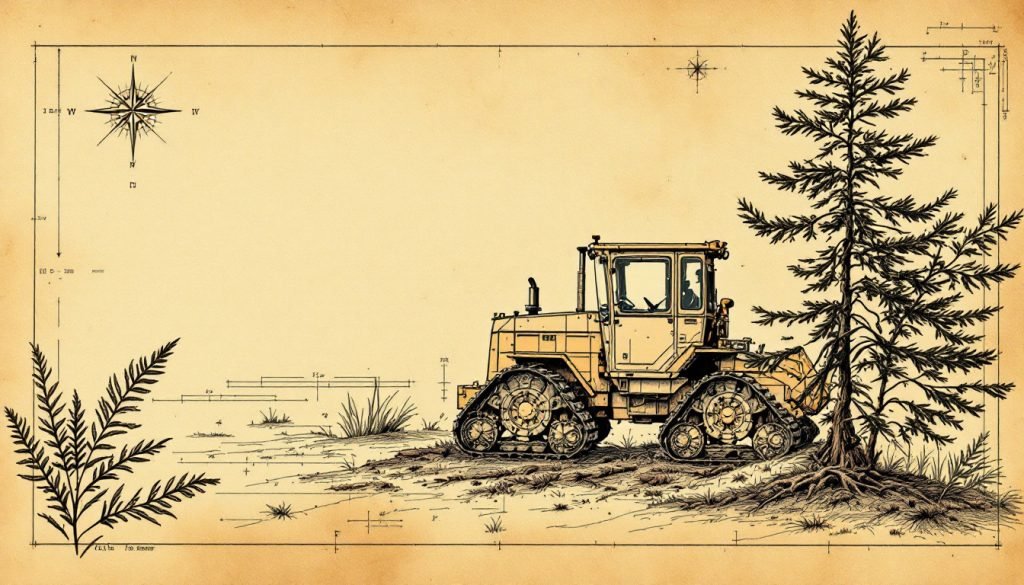
- Feller bunchers cut and accumulate trees using hydraulic saws and grabbing arms. Tracked models handle slopes to 35 degrees; whe acreage under 50 trees rarely justifies costs. Commercial operations achieve 60-100 trees per hour at $3-8 per tree for 6-16 inch DBH trees. Urban settings with tight spacing require alternative equipment due to 15-20 foot boom clearance needs. Professional site assessment costing $500-1,500 typically credits toward project if work proceeds.
You’re standing at the edge of a planned clearing project, watching contractors unload massive equipment that looks nothing like traditional chainsaws. The operator climbs into what appears to be a tracked excavator with a giant grabbing claw mounted where the bucket should be. Within minutes, this machine is severing 20-inch diameter pines at ground level and neatly stacking them like pickup sticks. This is your first encounter with a feller buncher, the workhorse that has transformed commercial tree removal from a labor-intensive chainsaw operation into a precise, mechanized process.
As Michael J. Hartman, ISA Board Certified Master Arborist, I’ve witnessed this technology evolve from experimental prototypes in the 1970s to the sophisticated machines that now handle 85% of commercial timber harvesting. Understanding what a feller buncher is – and isn’t – matters whether you’re a property owner negotiating land clearing, a municipality planning right-of-way maintenance, or simply curious about the machinery reshaping our forests. By the end of this article, you’ll know exactly how these machines operate, when they’re appropriate, and what alternatives exist for different scenarios.
The Mechanical Heart: How Feller Bunchers Actually Work
A feller buncher combines three functions in one tracked or wheeled platform: cutting, grabbing, and temporary holding. The cutting mechanism sits at the heart of the attachment – either a hydraulic chainsaw bar up to 42 inches long or a disc saw with replaceable carbide teeth spinning at 2,000+ RPM. This saw assembly mounts on a knuckle boom that can articulate 270 degrees, allowing cuts at precise angles regardless of terrain slope.
The grabbing mechanism, called accumulators or arms, consists of two or three hydraulic-powered steel arms that close around the tree trunk. These arms generate 40,000+ pounds of clamping force, enough to control trees up to 36 inches diameter at breast height (DBH). Modern machines can hold 4-6 smaller trees simultaneously before depositing them in bunches for skidders or forwarders to collect.
Power comes from turbocharged diesel engines producing 200-350 horsepower, driving variable-displacement piston pumps capable of 60+ gallons per minute flow rates. This hydraulic power translates to cutting speeds of 3-5 seconds per 12-inch diameter tree. The operator sits in a climate-controlled cab with joystick controls and multiple camera views, including thermal imaging for night operations.
Term: A feller buncher is a self-propelled forestry machine that cuts standing trees at the stump and places them in piles (bunches) for subsequent removal by other equipment.
Design Variations: Track vs Wheel and Head Types
The fundamental divide in feller buncher design starts with mobility. Tracked machines dominate steep terrain and soft ground conditions, distributing 40,000-60,000 pounds across wide tracks that exert less than 5 PSI ground pressure. This prevents soil compaction and allows operation on slopes up to 35 degrees. Wheeled versions, typically on four oversized tires, excel on flat to moderate terrain where speed matters – they can travel 15+ mph between cutting sites compared to 5 mph for tracked units.
Cutting head design determines tree size capacity and operational specialization. Disc saw heads excel in hardwoods and larger diameter trees, with 30-inch cutting capacity and faster cutting speeds. Chainsaw bar heads provide cleaner cuts in softwoods and allow precise directional felling, crucial near buildings or infrastructure. The newest innovation – shear heads – use massive hydraulic blades to cut trees up to 20 inches diameter in a single bite, ideal for plantation thinning operations.
Accumulation capacity varies dramatically. Small heads hold 3-4 trees up to 8 inches diameter, while large heads can accumulate 8+ smaller trees or single trees up to 36 inches. This specification directly impacts productivity – a high-accumulation head can reduce machine travel by 60% compared to cutting and immediately dropping each tree.
Appropriate Applications: Where Feller Bunchers Excel
Commercial timber harvesting represents the primary application, particularly in pine plantations and mixed hardwood stands. In southeastern United States softwood operations, a single feller buncher can harvest 100-150 tons per day, equivalent to a 6-person chainsaw crew. The machines excel in uniform stands where trees are straight and relatively free of major branches up to 20 feet height.
Right-of-way clearing for utilities and road construction provides another major application. Electric utility companies use specialized mini-feller bunchers with insulated booms that can work within 50 feet of energized transmission lines. These compact units, weighing 15,000-25,000 pounds, navigate tight spaces while cutting trees up to 18 inches diameter that threaten power infrastructure.
Wildfire fuel reduction projects increasingly rely on feller bunchers for selective thinning. The machines can target specific diameter classes – say, removing all trees 4-12 inches DBH while leaving larger fire-resistant specimens. This precision creates defensible space around communities while maintaining forest health, something impossible with traditional clearcutting methods.
Pro Tip: When negotiating land clearing contracts, ask contractors about bunch spacing. Professional operators place bunches 50-75 feet apart in straight rows, making subsequent skidding operations 40% more efficient than random bunching. This seemingly minor detail can save thousands in total project costs.
Limitations and Constraints: When Not to Use
Urban tree removal rarely suits feller buncher capabilities. The machines require 15-20 feet minimum spacing between trees for boom articulation, impossible in most residential settings. Underground utilities, septic systems, and landscape features create obstacles that specialized urban forestry equipment handles better.
Extremely rocky terrain presents another limitation. While tracks handle slopes well, buried rocks larger than 12 inches diameter can damage cutting heads and tracks. Most contractors avoid areas with more than 5% exposed rock coverage, opting instead for traditional hand felling methods.
Tree species characteristics also constrain effectiveness. Hardwood species with significant branching below 20 feet height, like mature oaks with low limbs, tangle in the accumulation arms. Similarly, trees with pronounced lean or sweep (curvature) require individual directional felling techniques that exceed machine capabilities.
Environmental restrictions increasingly limit use near water bodies. Most states require 25-100 foot no-cut buffers around streams and wetlands, making hand felling necessary for these sensitive areas. The machines also struggle in soft bog conditions where ground pressure exceeds soil bearing capacity.
Economic Considerations: Cost vs Efficiency Analysis
Operating costs for feller bunchers range from $300-500 per productive machine hour (PMH), including fuel, maintenance, and operator wages. However, productivity rates of 60-100 trees per hour in plantation conditions translate to $3-8 per tree for trees 6-16 inches DBH. This compares favorably to chainsaw crews costing $8-15 per tree for the same diameter class.
Capital investment runs $400,000-800,000 for new machines, creating high fixed costs that favor contractors handling large acreages. Most operators require 500+ acres annually to justify equipment payments. This economic reality means individual landowners rarely purchase machines, instead hiring contractors at $1,500-2,500 per day plus mobilization fees.
Hidden costs include site preparation requirements. Feller bunchers need 12-14 foot wide access trails every 500-600 feet for efficient bunch placement. Creating these trails adds $500-1,000 per mile in previously undisturbed forest, potentially impacting total project economics.
Environmental Impact and Best Management Practices
Modern feller bunchers significantly reduce soil disturbance compared to historical logging methods. Wide tracks distribute weight evenly, creating ruts less than 2 inches deep in most conditions. This contrasts with rubber-tired skidders that can create 6-12 inch ruts on the same terrain. However, operations during wet conditions still cause unacceptable soil compaction and erosion.
Residual stand damage presents the primary environmental concern. Inexperienced operators can scar remaining trees while maneuvering, creating entry points for insects and disease. Professional operations maintain 3+ feet clearance from residual trees and use designated travel corridors to minimize impact.
Bird nesting season restrictions limit operations in many regions. Most states prohibit tree cutting during March-August for neotropical migrant birds, creating seasonal windows for feller buncher operations. Planning harvests during dormant seasons (November-February) avoids these restrictions while taking advantage of frozen ground conditions that reduce soil impact.
Alternatives and Complementary Equipment
Harvester processors combine felling and delimbing functions, representing the next technological evolution. These machines cut, de-limb, and buck trees to specific log lengths in one pass, eliminating the need for separate processing equipment. However, they cost 50-100% more than basic feller bunchers and excel primarily in plantation monoculture scenarios.
For smaller acreages, purpose-built skid steers with forestry attachments provide feller buncher capabilities at reduced scale. These units, typically 75-125 horsepower, handle trees up to 14 inches diameter while fitting in tighter spaces. Operating costs drop to $150-250 per PMH, making them economically viable for 50-200 acre projects.
Traditional hand felling remains essential for complex scenarios. Steep slopes exceeding 35 degrees, selective removal in mixed species stands, and hazard tree removal near infrastructure all require skilled chainsaw operators. Most professional operations combine methods – feller bunchers for accessible areas, hand crews for challenging terrain and sensitive areas.
What to Do Next: Making Informed Decisions
Start by assessing your specific situation against feller buncher capabilities. Measure tree diameters at breast height – if most trees fall between 6-20 inches DBH and terrain slopes are under 30 degrees, feller bunchers likely make economic sense. Count trees per acre – densities below 50 trees per acre rarely justify mechanized harvesting costs.
Contact certified arborists or professional foresters for site assessments. These experts evaluate species composition, terrain challenges, and access requirements while providing detailed cost comparisons between mechanized and hand felling options. Expect assessment fees of $500-1,500, which contractors typically credit toward project costs if you proceed.
Request detailed bids from multiple contractors specifying machine types, bunch spacing, and site restoration requirements. Professional bids include mobilization costs, daily rates, and estimated completion timelines. Require proof of insurance specifically covering mechanized logging operations – standard tree service insurance often excludes this equipment class.
Finally, verify permits and environmental compliance. Most counties require timber harvesting permits even for private land, while state forestry departments may need notification for operations exceeding 5 acres. Starting this process 30-60 days before planned operations prevents costly delays and ensures regulatory compliance.