Harvester Visibility Safety: Demystified
Learn how articulated, skid-steer, tracked, and wheeled forestry chassis differ in slope limits, soil impact, and safety to select the right machine for harv...
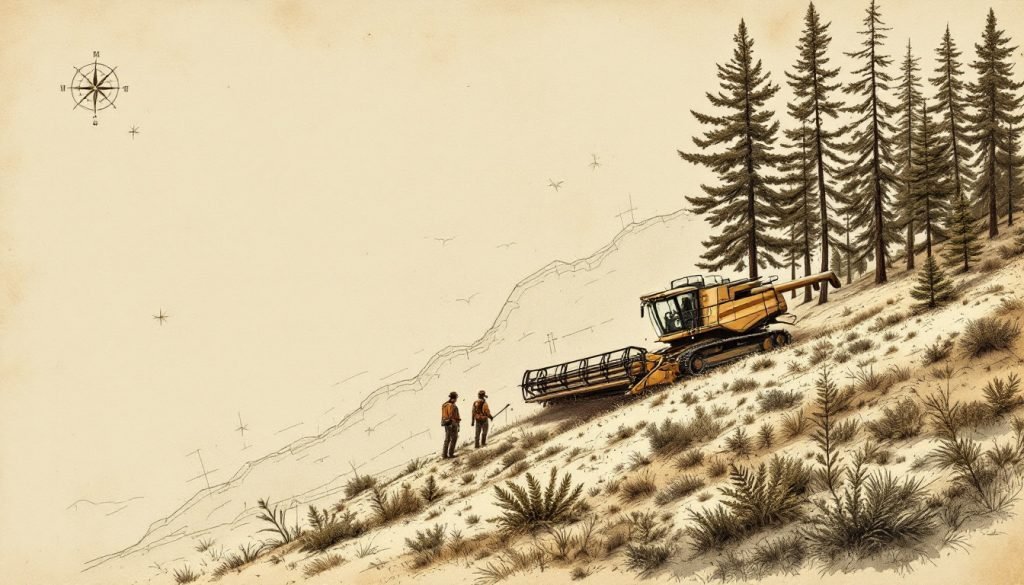
- Chassis choice dictates max slope, soil damage, and OSHA compliance.
When a landowner watches a professional crew drop a 36-inch white oak on a 35° slope without scarring the forest floor, the first question is usually “What machine is that?” The second is “Can I rent one?” The answer depends entirely on chassis configuration—the fundamental frame and running gear that determines whether a piece of equipment can work safely on that slope, minimize soil compaction, and meet OSHA’s strict cab protection standards.
Forestry equipment evolved from construction cousins, but engineers have redesigned every chassis style to cope with steeper grades, uneven terrain, and the shock loads of dragging logs. As Michael J. Hartman, ISA Board Certified Master Arborist, explains, “Selecting the wrong chassis for the site is the fastest way to double your hourly cost through stuck machines, rutting fines, or worse—rollover injuries.” By the end of this guide, you will know exactly which chassis match which terrain and task, how slope limits are calculated, and what OSHA requires before you turn the key.
Chassis Types and Their Original Purposes
Modern forestry machines build on seven basic chassis forms: articulated, excavator base, skid steer, compact tracked loader, crane, tricycle, and crawler. Each started in construction or agriculture and was then modified for tree work.
Articulated carriers use a hinge joint between cab and rear to steer, giving a tight turning radius while keeping all wheels on the ground. Originally seen in articulated dump trucks, they now serve as harvester and forwarder bases in North American softwood stands.
Excavator bases retain the house-and-boom layout but add heavier counterweights and high-drawbar tracks to pull delimbed stems uphill. The same base can swap a felling head for a grapple, making it the most versatile conversion.
Skid steers started as landscape loaders. Outfitting them with tracks instead of wheels (compact track loader conversion) keeps ground pressure below 4 psi—about half that of a walking person—greatly reducing soil compaction on wet sites.
Crane and tricycle configs are rare but appear on cable-yarding towers and steep-slope harvesters where the machine itself never leaves a landing pad. Crawlers, derived from bulldozers, provide the lowest center of gravity and highest drawbar pull for winching operations.
Chassis: The load-bearing framework of a machine, including engine placement, axles or tracks, and cab mounting, that dictates stability, flotation, and slope limits.
Three Factors That Limit Slope Operation
Each chassis is rated for a maximum operating slope based on three independent limits: safety, gradeability, and soil disturbance. Ignoring any one of them leads to stuck machines or OSHA citations.
Safety is the slope at which the machine will roll or tip before any mechanical failure. Articulated wheeled carriers typically stabilize to 35% (19°) side slope and 60% (31°) front slope when properly ballasted. Rubber-tracked machines can add 5–7° to those numbers thanks to a lower center of gravity.
Gradeability is the steepest incline the drivetrain can climb before engine torque, hydraulic flow, or fluid pickup becomes limiting. On loose soils, gradeability often drops 10–15% below safety ratings because wheel slip consumes power. A 30° theoretical limit becomes 25° in practice.
Soil disturbance is terrain-specific. Even if the chassis can climb a 20° slope without tipping, the weight per square inch can shear the duff layer and start erosion. Crawler tracks distribute 8–12 psi, skid-steer tracks 4–5 psi, and dual wheels on articulated carriers 9–14 psi, so the same slope may be acceptable for a tracked machine but banned for rubber-tired equipment.
Pro Tip: Before signing a rental contract, measure actual slope with a clinometer at the steepest point the machine will work—not at the landing—and reduce published limits by 20% to account for wet soil or wind load when carrying a full log.
Tracks Versus Wheels: Trade-offs in Real Numbers
The debate is not philosophical; it is measurable in ground pressure, fuel burn, and hourly cost.
Steel tracks on a 20-ton purpose-built harvester run 6.5 psi ground pressure, letting the machine climb 36° slopes while leaving ruts less than 1 inch deep on firm loam. Switch to the same weight on 30.5L-32 flotation tires and ground pressure jumps to 14 psi; ruts deepen to 3–4 inches, and the safe side-slope limit drops to 20°.
However, tracked machines burn 15–20% more fuel on flat ground because track friction increases rolling resistance. Rubber-tracked conversions on CTL chassis split the difference: 4.2 psi ground pressure, 30° slope capability, and only 8% fuel penalty—often the sweet spot for contractors working mixed terrain.
Maintenance favors wheels. A punctured skid-steer tire costs $400 and 30 minutes to change. A broken rubber track runs $4,000 and four hours. Steel tracks last 6,000–8,000 hours but require daily tensioning and undercarriage clean-out to prevent frozen rollers in winter.
| Chassis Type | Ground Pressure (psi) | Max Side Slope | Typical Fuel Burn (gph) |
|---|---|---|---|
| Steel-tracked harvester | 6.5 | 36° | 6.8 |
| Rubber-tracked CTL | 4.2 | 30° | 4.2 |
| Articulated wheeled | 12–14 | 19° | 4.5 |
| Skid-steer tires | 18–22 | 15° | 3.9 |
OSHA Cab Protection: Construction Versus Forestry
OSHA Standard 1910.266 mandates two protective structures that construction machines often lack: rollover protective structures (ROPS) and falling object protective structures (FOPS). Converting a construction chassis for forestry therefore always costs more than the attachment price.
ROPS must withstand 1.5 times the machine weight applied laterally, plus 0.75 times the weight applied vertically. FOPS must stop a 500-pound object dropped from 17.5 feet. Mesh screens around the cab protect operators from cables under tension, which can whip at 70 mph if a skyline breaks.
Retrofitting a 20-year-old excavator with certified forestry cab guards typically runs $18,000–$25,000, negating any savings from buying used construction iron. Contractors often discover this only after an OSHA inspection, when the citation for non-compliant equipment can reach $13,653 per day.
Regional Soil and Climate Variations
Pacific Northwest volcanic soils handle 12 psi without rutting; Southeast Piedmont clay shears at 7 psi when saturated. In frost-heave zones, tracked machines must carry 16-inch grouser shoes to bridge frozen ruts, increasing ground pressure and negating some flotation advantage.
Winter operations add another constraint: steel tracks can climb icy 25° slopes, but rubber tracks lose tractive effort below 20°F as the rubber stiffens. Articulated wheeled machines with tire chains maintain mobility down to 0°F but increase ground pressure to 20 psi, so they remain on landings and roadbeds.
Contractors working hurricane blowdown quickly learn that bog mats under any chassis save soil and time. A single 4×8-foot, 1.5-inch composite mat distributes 50,000 pounds over 32 square feet, dropping pressure below 2 psi and letting wheeled machines work where tracks alone would bog down.
Choosing Chassis for Specific Harvesting Tasks
Match the chassis to the job, not the other way around.
Clear-cut on flat, dry ground: An articulated wheeled harvester with 30.5L tires moves fastest between trees and leaves acceptable rutting on sandy loam. Fuel efficiency and roading speed make this combo profitable when stems exceed 100 per acre.
Selective thinning on 25° slopes: A purpose-built tracked harvester with 36-inch grouser shoes climbs slopes while pulling whole stems to a skyline chute. The extra weight and steel tracks justify themselves with reduced yarding distance and no winch lines.
Urban tree removal in tight backyards: A rubber-tracked mini-excavator with grapple saw attachment fits through 36-inch gates, crosses lawns with minimal rutting, and lifts 5,000-pound logs over fences. The same machine can grind the stump the same day, eliminating secondary mobilization.
Site-Specific Chassis Checklist
- Measure steepest working slope with clinometer
- Identify soil type and moisture regime
- List gate widths, road weight limits, and overhead lines
- Compare hourly rental cost versus fuel and rutting penalties
- Verify cab has current OSHA FOPS/ROPS certification sticker
What to Do Next
Before the next harvest or large-tree removal, print the slope map and soil survey for your site. Circle the steepest 10% of the work area; that determines the chassis you must select. Contact three rental houses or contractors and ask for their chassis model numbers, then cross-check the ground pressure and slope ratings in this guide. If any machine falls short, insist on bog mats or choose a tracked alternative—it is always cheaper than a rollover citation or a site restoration bill. And when weighing processor versus feller buncher options, remember that chassis choice underpins every other decision. Finally, consult the USFS equipment catalog for additional chassis specifications.