Excavator Attachment vs Dedicated: Explained
Choosing between an excavator attachment feller-buncher and a dedicated machine? This guide breaks down the real performance, cost, and operational differences.
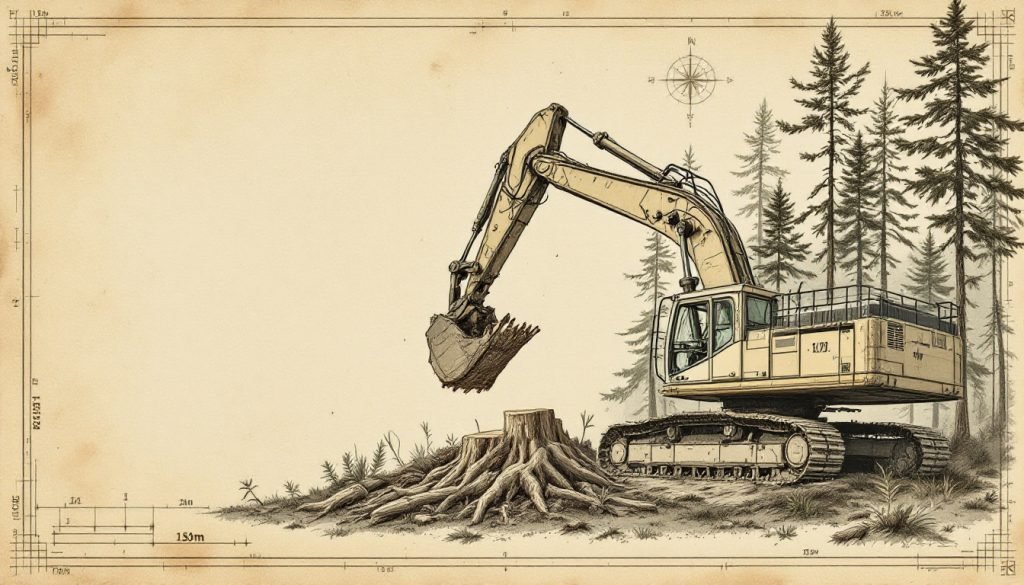
- Excavator attachment feller-bunchers deliver 40–60 GPM to the cutting head versus 80–120 GPM on dedicated machines. Production gaps are modest in small-diameter timber but widen sharply above 14 inches DBH. Dedicated machines offer superior ground pressure management, cab protection, and operator ergonomics. Attachment heads cost $40K–$120K versus $350K–$700K for a purpose-built dedicated feller-buncher. Match your choice to annual clearing volume, average timber diameter, and carrier machine utilization needs.
If you are managing a large-scale tree removal project, a timber harvest, or a land-clearing operation, you have almost certainly faced this question: do you run a feller-buncher head on your existing excavator, or do you bring in a purpose-built dedicated feller buncher? It sounds like a simple equipment decision, but the answer has serious implications for cycle times, operator fatigue, site damage, and total project cost. The wrong choice can turn a profitable clearing job into a money-losing slog.
The feller-buncher category covers a wide range of machines, from compact excavator-mounted accumulating heads to massive purpose-built tracked units with 28-inch cutting capacity and purpose-engineered drive systems. Understanding what separates these two approaches mechanically, operationally, and economically is essential before you commit equipment to a job site. I am Michael Hartman, ISA Board Certified Master Arborist (TX-0198B), and I work alongside logging and land-clearing crews regularly enough to know that this decision is rarely as obvious as equipment dealers make it sound.
By the end of this article, you will understand how each machine type functions, where each genuinely excels, what the real cost-per-acre math looks like, and how to match the right tool to your specific terrain, timber size, and production goals.
What Is a Feller-Buncher? Defining the Core Machine
Before comparing attachment versus dedicated, it helps to be precise about what a feller-buncher actually does. The machine performs two linked functions: it severs a standing tree at the base using either a disc saw, bar saw, or shear head, and it accumulates multiple stems in its arms before placing them as a bunch for a skidder or forwarder to retrieve. That accumulation function is what separates a feller-buncher from a simple harvester head, and it is central to the attachment-versus-dedicated debate.
Feller-Buncher: A self-propelled or carrier-mounted forestry machine that cuts standing trees at the stump and holds multiple stems simultaneously before depositing them in organized bunches for downstream processing or extraction.
Disc saw heads are the most common cutting mechanism in production forestry. A typical 22-inch carbide-tipped disc saw spinning at 1,200 to 1,500 RPM can fell a 16-inch DBH (diameter at breast height) softwood in under three seconds. Shear heads use scissor-action blades and are better suited to smaller-diameter material, typically under 10 inches, making them common on compact excavator attachments used in utility right-of-way clearing. Bar saw heads occupy a middle ground, handling larger diameter material than shears but cutting more slowly than disc saws.
Understanding which cutting head is mounted on either machine type matters because the head itself often determines the diameter ceiling of the operation, regardless of whether the carrier is an attachment or a dedicated unit.
How Excavator Attachment Feller-Bunchers Work
An excavator attachment feller-buncher mounts a purpose-built forestry head onto the stick of a conventional hydraulic excavator, typically a 20- to 45-ton machine. The excavator’s existing hydraulic system powers the head’s rotation, clamping arms, and cutting mechanism. Most attachment heads in this class use a disc saw or shear cutting system and are designed to handle trees from 4 inches up to roughly 18 inches DBH, depending on the host machine’s hydraulic flow and pressure ratings.
The primary appeal is obvious: if you already own a 30-ton excavator, adding a forestry head costs significantly less than purchasing a dedicated machine. Attachment heads from manufacturers like Quadco, Tigercat, and Fecon typically run between $40,000 and $120,000 depending on cutting capacity and accumulation design. That is a fraction of the $350,000 to $700,000 price tag on a new dedicated tracked feller-buncher. For contractors who do occasional clearing work between excavation contracts, the attachment route makes financial sense.
The limitation is hydraulic performance. A standard excavator hydraulic system delivers 40 to 60 gallons per minute (GPM) to the attachment, which is adequate for light to moderate timber but falls short of what a disc saw head needs for sustained high-production cutting. Dedicated forestry machines are engineered from the ground up with hydraulic systems delivering 80 to 120 GPM specifically to the cutting head, which translates directly into faster disc speeds, quicker recovery between cuts, and higher daily stem counts.
Pro Tip: Before mounting a feller-buncher head on your excavator, verify the machine’s auxiliary hydraulic flow and pressure specs against the head manufacturer’s minimum requirements. Running a disc saw head on insufficient flow does not just slow production — it overheats the hydraulic system and accelerates pump wear. I have seen contractors burn through a $12,000 main pump in a single season by ignoring this spec.
How Dedicated Feller-Bunchers Work
A dedicated feller-buncher is a purpose-engineered machine where every system — engine, hydraulics, undercarriage, cab, and boom geometry — is designed specifically for the task of felling and bunching trees. The two dominant configurations are wheeled and tracked. Wheeled dedicated units like the John Deere 843L or Tigercat 870 operate best on firm, relatively flat terrain and offer faster travel speeds between cutting areas. Tracked units handle steep slopes, wet ground, and rocky terrain that would immobilize a wheeled machine.
The boom geometry on a dedicated feller-buncher is purpose-designed for forestry work. The reach, swing arc, and head positioning are optimized to minimize machine repositioning between cuts. An experienced operator on a dedicated machine can fell and bunch 400 to 600 stems per hour in favorable conditions. That same operator on an excavator attachment setup in comparable timber might achieve 150 to 250 stems per hour — a production gap that compounds quickly across a multi-day project.
Dedicated machines also carry purpose-built cab protection systems: full FOPS (Falling Object Protective Structure) and ROPS (Roll-Over Protective Structure) rated specifically for forestry environments, polycarbonate windows rated for branch impact, and debris-deflecting screens. Excavator cabs can be retrofitted with forestry guarding, but factory-integrated protection on a dedicated machine is more comprehensive and typically better engineered for the specific impact loads of felling work.
Production Rate Comparison: Where the Numbers Diverge
Production rate is where the attachment-versus-dedicated decision becomes most concrete. The gap between the two approaches widens as timber size increases and terrain becomes more demanding. In small-diameter material — say, a right-of-way clearing job with stems averaging 6 to 10 inches DBH on flat ground — an excavator attachment can perform surprisingly close to a dedicated machine. The hydraulic limitations matter less when the cutting demand is modest, and the excavator’s reach and swing can actually be advantageous for precise placement in tight corridors.
| Factor | Excavator Attachment | Dedicated Feller-Buncher |
|---|---|---|
| Typical cutting capacity | Up to 18 inches DBH | Up to 28+ inches DBH |
| Hydraulic flow to head | 40–60 GPM | 80–120 GPM |
| Estimated stems/hour (small timber) | 150–250 | 300–450 |
| Estimated stems/hour (large timber) | 80–140 | 300–500 |
| Machine acquisition cost | $40K–$120K (head only) | $350K–$700K |
| Versatility between jobs | High — excavator serves multiple roles | Low — single-purpose machine |
| Slope capability (tracked) | Moderate | High (purpose-built stability) |
As timber diameter climbs above 14 inches and terrain becomes irregular, the dedicated machine’s advantages compound. The engineered hydraulic system maintains disc saw speed through large-diameter cuts without the pressure drop that plagues excavator-mounted heads. The dedicated machine’s purpose-built boom geometry also reduces the number of machine repositioning moves per acre, which is a significant hidden time cost that rarely appears in simple stems-per-hour comparisons.
Ground Disturbance and Site Impact Considerations
From an arboricultural and land management perspective, ground disturbance is a critical factor that often gets overlooked in pure production comparisons. Dedicated tracked feller-bunchers, particularly modern low-ground-pressure models, are engineered to minimize soil compaction. Wide track configurations can reduce ground pressure to 4 to 6 PSI — comparable to a person walking — which matters enormously when residual stand management or site restoration is part of the project scope.
Excavators, even those with wide track shoes, are not optimized for low ground pressure in forestry applications. A standard 30-ton excavator exerts 7 to 10 PSI ground pressure, and the machine’s operational pattern — stationary swinging rather than continuous forward travel) concentrates compaction in specific zones. On sites where soil health, drainage, or replanting are post-clearing priorities, this distinction is meaningful. Compaction within the top 12 inches of soil can reduce pore space by 30 to 40 percent, directly impairing root development for any replanted or residual trees.
Dedicated feller-bunchers also tend to produce cleaner, more consistent stump heights. The purpose-built boom geometry allows the operator to position the cutting head at a consistent 2 to 4 inch stump height across varied terrain, which matters for site cleanup, stump treatment, and regrowth management. Excavator-mounted heads can struggle to maintain consistent stump height on uneven ground because the excavator’s boom geometry was not designed for that precision at ground level.
Common Mistakes When Choosing Between the Two
Common Mistakes to Avoid
- Ignoring hydraulic compatibility: Mounting a high-flow disc saw head on an excavator with insufficient GPM output causes overheating, slow disc recovery, and premature pump failure — always verify flow and pressure specs before purchase.
- Underestimating production gaps on large timber: Contractors often benchmark attachment performance on small-diameter test cuts, then discover the gap widens dramatically when average DBH exceeds 14 inches on the actual job.
- Overlooking mobilization costs for dedicated machines: A dedicated feller-buncher requires a lowboy trailer and a Class 8 truck to move between sites, adding $500 to $1,500 per mobilization — a real cost on multi-site contracts with frequent moves.
- Assuming attachment versatility always wins: The ability to swap the excavator back to a bucket is valuable, but only if you actually have other excavation work lined up. A dedicated machine sitting idle costs money too, but so does an attachment head that limits your excavator’s availability for its primary role.
Operator Skill and Fatigue Factors
Operator experience and fatigue are underappreciated variables in this comparison. Dedicated feller-buncher cabs are ergonomically designed for sustained forestry operation: joystick controls are positioned for minimal arm travel, seat suspension is tuned for the specific vibration frequencies of felling work, and visibility lines are optimized for the cutting head position. An experienced dedicated-machine operator can maintain high production rates across an 8 to 10 hour shift with manageable fatigue.
Operating a feller-buncher head on an excavator demands more cognitive and physical effort because the machine’s control layout and boom geometry were not designed for this task. The operator must compensate for suboptimal head positioning using boom and stick movements that a dedicated machine handles automatically through purpose-built linkage geometry. Over a full shift, this compensation increases operator fatigue and introduces more variability in cut quality, stump height, and bunch placement consistency.
Training time also differs. An operator transitioning from excavation work to excavator feller work can typically achieve competent production within two to three weeks. Transitioning to a dedicated feller-buncher from excavator work takes longer — typically four to eight weeks to reach efficient production — because the machine’s operational logic is fundamentally different. This training investment is real and should factor into project scheduling.
Making the Right Call for Your Operation
The attachment-versus-dedicated decision ultimately comes down to three variables: your average timber diameter, your annual clearing volume, and your machine utilization model. If you clear fewer than 500 acres per year, work primarily in small-diameter material under 14 inches DBH, and need your carrier machine for other work between clearing contracts, an excavator attachment is the financially sound choice. The production gap is manageable, the capital outlay is lower, and the machine versatility adds real value.
If you are running more than 1,000 acres per year in mixed or large-diameter timber, the production math shifts decisively toward a dedicated machine. The stems-per-hour gap translates directly into project duration and labor cost. A dedicated machine that completes a 200-acre job in 12 days versus an attachment setup requiring 20 days represents a meaningful difference in crew costs, equipment rental, and contract scheduling flexibility.
Decision Checklist Before Committing to Either Option
- Confirm average timber DBH on your primary job types — under 14 inches favors attachment, over 14 inches favors dedicated
- Calculate annual clearing acres and compare cost-per-acre for each option at your actual volume
- Verify your excavator’s hydraulic flow and pressure output against the attachment head’s minimum specifications
- Account for mobilization costs if the dedicated machine must move frequently between sites
- Assess terrain — steep slopes and wet ground favor purpose-built tracked dedicated machines
- Consider whether your excavator has other contracted work that the attachment head would displace
There is no universal right answer here, but there is always a right answer for your specific operation. Run the numbers honestly, benchmark against your actual timber conditions, and resist the temptation to let equipment familiarity or upfront cost be the only deciding factors. The machine that fits your production reality will always outperform the machine that fits your budget on paper.