Cut-to-length vs Full-tree: The Real Differences
Master Arborist breaks down Nordic CTL harvesting—where it beats feller-buncher systems, where it stalls, and how the same principles guide urban tree removals.
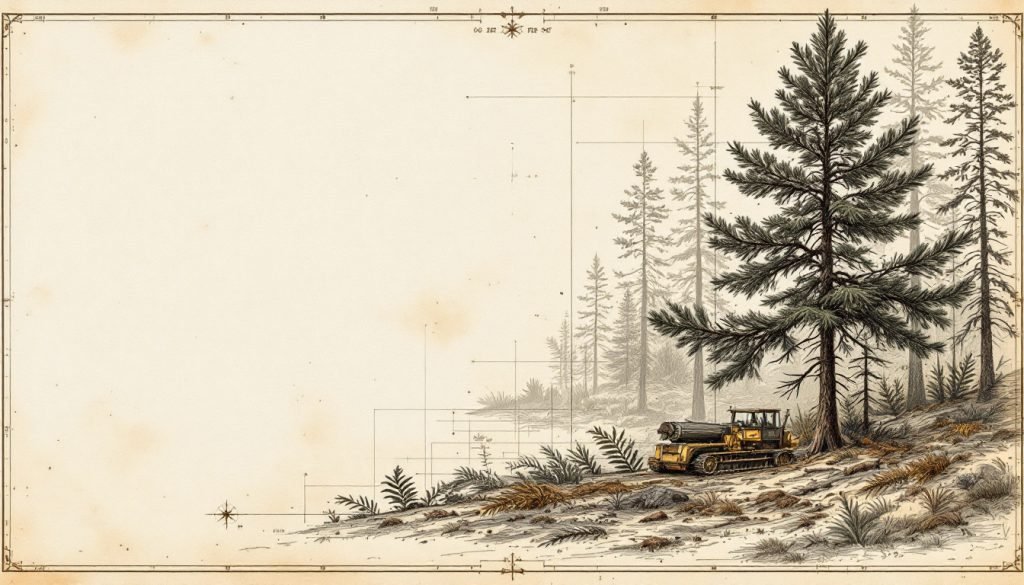
- CTL harvester replaces feller-buncher + skidder with one machine and forwarder. Works when tree volume <60 ft³, soil bearing <4 tons/ft², and mill pays clean-wood premium. Slash mat from CTL reduces soil ruts and protects residual roots. Capital cost $650k vs $350k feller-buncher; ROI hinges on merchandizing premium. Score 4+ on the five-point checklist before specifying CTL over conventional systems.
You’re staring at a mixed-species woodlot that needs to come out for a new subdivision. The logger proposes cut-to-length (CTL) harvesting instead of the traditional feller-buncher/grapple-skidder show you’ve seen on every job site south of the Mason-Dixon. Will the small Scandinavian machines really beat a 250-hp feller-buncher and tandem skidders? Or will the job stall in mud season, eat your budget, and leave piles of slash everywhere?
Cut-to-length harvesting—developed in Sweden and Finland during the 1970s—has become the default prescription in Nordic forests for good reasons: lower soil disturbance, better merchandizing, and the ability to work on frozen or snow-covered ground. Outside Scandinavia, adoption has lagged, even on tracts where CTL should dominate. In this article, Michael J. Hartman, ISA Board Certified Master Arborist, distills the 2025 Forest Engineering review and decades of field observation to show you exactly when CTL makes money, where it fails, and how urban arborists can borrow the same thinking for confined-space removals.
What Cut-to-Length Harvesting Actually Is
CTL replaces the traditional two-machine cycle (feller-buncher plus skidder) with one purpose-built harvester and a forwarder. The harvester—a tracked or wheeled carrier with a telescopic boom and processing head—fells, delimbs, bucks, and sorts saw logs, pulpwood, and biomass into neat piles right where the tree stood. The forwarder then picks up the sorted assortments and shuttles them to the landing on rubber tires, leaving the slash spread as a protective mat.
Term: Processing head—hydraulic attachment that can grip, chainsaw-cut, and manipulate a tree while sensors measure diameter and length to optimize bucking decisions in real time.
The key difference is that logs never touch the ground until they reach the landing, eliminating the dirt and rock contamination that downgrades southern yellow pine chip-n-saw or hardwood saw logs. The system also allows precise length control: if the mill needs 16 ft 3 in instead of 16 ft 6 in to fit a ship’s hold, the operator keys it in and every stem is cut exactly.
The Biology & Mechanics Behind the Method
CTL shines where soil structure and residual trees matter. A single-grip harvester exerts 5–7 psi ground pressure on wide tracks, about one-third of a rubber-tired skidder dragging full tree lengths. That pressure differential keeps fine feeder roots of residual oaks and poplars intact, something Georgia Piedmont clay will thank you for after a 4-inch gully-washer.
From a mechanical standpoint, the processing head functions as a linear harvester. Two pairs of rollers feed the stem past a 0.404-in pitch harvester bar at 45 m/s chain speed, while delimbing knives strip branches down to a 1 cm stub. Optical sensors measure taper and sweep every 10 cm; onboard computer software runs bucking optimization algorithms that maximize value recovery based on mill prices. On a 14-inch DBH red pine, that can mean an extra $12–18 per tree compared to manual bucking.
Pro Tip: In mixed-species stands, program the harvester to drop low-value tops in the skid road first. Forwarder tires will push the slash into the soil, creating a 6-inch organic mat that prevents rut formation even during spring break-up.
Where CTL Beats Conventional Systems
CTL economics flip when at least three of the following are true: slope under 35%, stem volume under 60 ft³ per tree, soil bearing capacity under 4 tons/ft², or residual stand value exceeds $200 per acre. In practical terms, that means most second-growth loblolly plantations on Coastal Plain sandhills, northern hardwood shelterwoods, or any tract where you’re removing biomass for energy chips while saving sawtimber for a future harvest.
Productivity numbers from Georgia Kraft trials show a single-grip harvester cutting and processing 55–65 trees per productive machine hour (PMH) in 25-year-old loblolly, matching the output of a feller-buncher but eliminating the second pass. Forwarder productivity averages 12–15 cords per PMH on 600-foot extraction distances—about 1.5 times the payload of a skidder, but at half the ground pressure.
Urban parallels exist too. When we remove 30-inch water oaks from a backyard with a 42-inch gate opening, the mini-harvester head on our tracked lift processes the tree in 8-foot sections, feeding pieces directly into a chip truck. No dragging log lengths across St. Augustine sod equals happy homeowner and zero skid-steer ruts.
Barriers That Keep CTL Out of Southern Forests
Despite the Nordic pedigree, CTL struggles south of 40° latitude for four reasons: capital cost, fuelwood markets, log size, and crew culture. A purpose-built harvester runs $650,000 new versus $350,000 for a high-spec feller-buncher. Southern mills still buy tree-length pine and buck it themselves, so the merchandizing advantage evaporates.
Then there’s the fuelwood trap. Nordic mills pay $40–45 per green ton for 8-foot pulpwood; southern biomass plants pay $18–22. CTL’s extra processing pass becomes dead cost if the mill doesn’t reward clean, sorted material. Finally, southern plantation pine grows faster and bigger—20-inch DBH at 25 years—pushing average stem volume above the 60 ft³ threshold where tree-length systems regain efficiency.
Diagnostic Checklist: Should You Specify CTL?
Run this 5-point test before specifying CTL
- Mean tree volume under 60 ft³ or 1.7 m³
- Extraction distance under 900 ft (275 m) one-way
- Soil bearing capacity under 4 tons/ft² or high erosion risk
- Residual stand worth at least $200 per acre after harvest
- Mill pays premium (>$15 per ton) for sorted, clean wood
If you score four or five, CTL will likely out-earn conventional. Three or fewer, run the numbers twice. Missing any single factor—like a mill that refuses tree-length—can swing the whole equation.
Regional & Species Variations That Matter
Pacific Northwest Douglas-fir CTL systems use 30-inch heads to handle 36-inch DBH old-growth residuals, but the harvesters ride on high-flotation tracks to float on volcanic soils. In the Lake States, CTL dominates aspen clearcuts because the species self-prunes, producing clean logs that mills pay a premium for. Across the South, CTL works in mixed bottomland hardwoods where you’re removing 12- to 16-inch cherrybark oak and sweetgum while leaving 20-inch oaks for acorn production.
Species-specific quirks: eastern hemlock slash decays slowly and creates a long-lasting mat; red maple slash compacts and rots within one season, so you need to forward immediately. Slash pine needles are acidic; spread them thin to avoid nutrient lockup in sandy Coastal Plain soils.
Professional vs DIY: When to Call the CTL Crew
Homeowners clearing five acres for pasture sometimes ask, “Can’t I just chainsaw and skid with my tractor?” For anything bigger than firewood, the answer is no. A CTL crew brings calibrated heads, certified operators, and $2 million in liability insurance. They also leave you with a site ready for reforestation: slash scattered, ruts avoided, and stumps flush to the ground.
That said, savvy landowners can borrow CTL principles. Rent a mini-harvester head for a tracked skid-steer to limb and buck trees in place, then shuttle logs with a small forwarder or grapple trailer. You won’t match production rates, but you’ll protect soils and avoid the cable logging ruts that plague small tracts.
When to Act
Best window: frozen ground or minimal 3-day dry spell. CTL machines can work in light rain, but rutting risk and grade loss increase sharply above 25% soil moisture.
What to Do Next
If your tract meets the five-point checklist above, get quotes from at least two CTL contractors. Ask for machine hours, fuel burn, and landing setup costs, then compare to a conventional tree-length crew on the same prescription. For urban removals, ask your arborist if they run mini-harvester heads on tracked lifts; the same slash-mat and sectioning benefits apply in a 30-foot backyard.
Finally, remember that CTL is a means, not an end. The goal is value recovery with minimal site impact. Whether you’re managing 500 acres of loblolly or removing a single heritage oak from a townhouse courtyard, the principles—measure twice, cut once, preserve soil—remain the same.