Diy vs Professional Tree Cutting: What an Arborist Would Pick
Master Arborist Michael J. Hartman explains when weekend pruning crosses into danger and when a certified pro saves money, liability, and your tree.
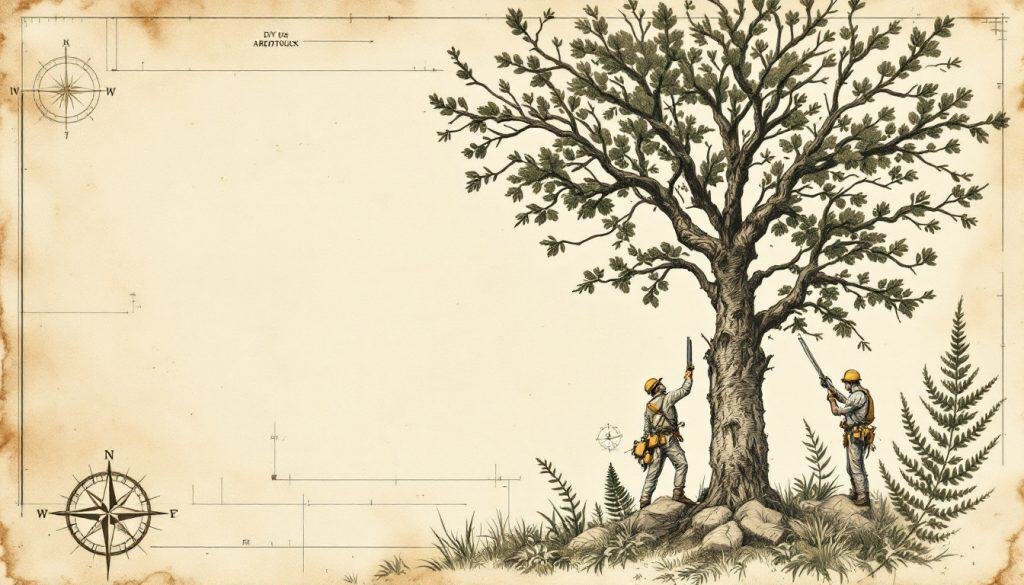
- DIY pruning is safe only under 3-inch diameter and 15-foot height. City ordinances fine $500 per inch for protected trees removed without permits. Oak and elm pruning outside July-January window risks deadly oak wilt spread. Professional aerial rescue gear and insurance start where ladders end. If replacement cost under branch exceeds 5× arborist quote, hire certified help.
You bought the pole saw, watched three YouTube videos, and the 30-foot red oak out front finally has that one dead limb you’ve stared at all winter. Do you lean the ladder against the trunk and start cutting, or is this the phone call that keeps you off the six o’clock news? Every year ISA-certified arborists like myself are called to homes where a “simple Saturday project” ends with a crushed roof, a saw in the ER, or a tree that never recovers from flush cuts. By the end of this guide you’ll know exactly which tasks are safe, legal, and cost-effective to tackle yourself—and which ones demand the training, insurance, and specialized equipment that only a professional carries.
Michael J. Hartman, ISA Board Certified Master Arborist TX-0198B, has spent three decades both cleaning up DIY disasters and politely handing homeowners a $40 hand saw for jobs they assumed required a bucket truck. The line between the two is clearer than most people think; it just isn’t printed on the tool label.
The Real Risk Spectrum: What Can Go Wrong
Gravity is only the first hazard. A 4-inch limb that weighs 80 pounds can generate 1,200 pounds of force when it pivots off a mis-placed notch. That load will snap an aluminum ladder rung, buckle a roof jack, or whip back and fracture a femur before you can finish the second cut. Beyond personal injury, incorrect pruning leaves entry wounds for pathogens like Hypoxylon canker and Bretziella fagacearum (oak wilt). One flush cut on a live oak in March can cost a Texas homeowner a $15,000 removal three years later—and insurance will not pay for “disease due to negligent pruning.” Finally, most municipalities now have tree preservation ordinances. In Austin, San Antonio, and Dallas, removing or “substantially altering” a tree over 19 inches diameter-at-breast-height without a permit triggers fines from $500 to $5,000 per inch. The City doesn’t care who made the cut; the property owner owes the money.
Substantial alteration: Removing more than 25% of the live crown or any branch larger than 4 inches diameter at the point of attachment during the growing season.
Understanding the stakes clarifies every decision that follows.
Jobs You Can Safely Handle with a $40 Saw
If every answer to the following three questions is “yes,” grab the hand saw and go:
- Is the branch smaller than 3 inches diameter at the collar?
- Can you reach it with both feet on the ground or a 6-foot step ladder on level turf?
- Is the branch more than 10 feet away from power lines, roofs, fences, or sidewalks?
That profile describes about 80% of low-hanging water-sprouts on mature oaks and the dead lower limbs of cedars. Use the three-cut method: undercut 6 inches out, top cut 8 inches out, final cut just outside the branch bark ridge. Sterilize the blade between trees with a spray of 70% isopropyl alcohol. Bag small debris, chip anything under 4 feet, and you’re done for the price of a Saturday morning.
Pro Tip: Buy a non-conductive fiberglass pole saw rated for 12 feet; aluminum poles conduct induction voltage even when you’re not touching the line.
The Gray Zone: When It Depends on Species, Season, and Side Lean
Branches between 3 and 6 inches diameter live in a twilight zone. A 5-inch sugar maple limb over open lawn is manageable; the same limb on a 30-degree lean toward your neighbor’s Tesla is not. Similarly, live oaks and elms pruned between February 1 and June 30 in central Texas carry a high oak-wilt transmission risk. If the branch is cracked but still partially attached, the hinge can fail unpredictably. For these scenarios, bring in a certified arborist for an hourly consultation ($150-$200). Often we make one controlled climb, rig the limb down in sections, and leave the smaller cleanup for you—saving $600 off the full-service price while keeping risk and liability on our insurance.
When to Act
Best window: mid-July to mid-January for oaks and elms. Outside this window, paint cuts immediately with latex pruning sealer if you must prune, but avoid the task entirely from February through June.
Work That Requires a Professional, Full Stop
Stop reading and dial an ISA certified arborist if any of the following apply:
- Height above 15 feet where a ladder would be required
- Any branch above a roof, power line, or public sidewalk
- Decay conks, cavities, or fungal brackets on the trunk or stem you plan to climb
- Crane access, rope-assist pulling, or need to drop limbs with rigging
- Trunk diameter over 19 inches DBH and removal of more than 25% crown
These situations require aerial rescue plans, static climbing lines rated to 5,400 lbs, and general liability coverage specifically endorsement CG 22 94 for tree work. Your homeowner policy will not back-fill a gap created by unlicensed tree operations.
Peninsula-Specific Legal Traps (and What They Cost)
Texas cities copy each other’s ordinances, so the same rules pop up from Plano to Pearland. In Austin, a protected tree is any 19-inch DBH or larger, measured at 4.5 feet above grade. Remove it without a permit and the fine is $500 per diameter inch—$9,500 on a 19-inch tree. Dallas adds a $2,000 “administrative fee” on top. Houston uses a point system: each caliper inch equals one point; accumulate 100 points in a single lot and you must replant 50% of those points on-site or pay into the reforestation fund at $200 per missing point. Translation: cutting one 30-inch pecan costs $6,000 in fees plus mandatory replants. Certified arborists know the thresholds, file the 5-page application, and post the yellow tag 48 hours before work begins. Homeowners who “didn’t know” still pay.
Common Mistakes to Avoid
- “It’s my tree, I can do what I want”: Municipal tree ordinances apply regardless of property lines; ignorance triples the fine.
- Topping to reduce height: Stimulates fast, weak regrowth that fails in wind storms and voids most arborist warranties.
- Using a roof as an anchor point: Ropes abrade shingles and void homeowner insurance when water damage is traced to nail holes.
Cost Thresholds: When DIY Savings Are Real vs. Illusory
Hand-saw pruning costs your time plus $40 in tools. A professional crew with a bucket truck bills $150-$250 per man-hour and adds $100-$150 per day for chipper and disposal. Sounds like easy math—until you price risk. Emergency room copays average $1,200; replacing a 4/12 asphalt roof section runs $650 per square; one re-spray for oak wilt averages $45 per inch DBH and must be repeated two more times. Suddenly the $600 you “saved” evaporates if one 5-inch limb dents a gutter. My rule: if the combined replacement cost of everything underneath the branch exceeds five times the arborist quote, hire the pro. Most homeowners discover that threshold is crossed when the branch is bigger than their wrist.
What to Do Next: A 60-Second Decision Checklist
Stand at the base of the tree and answer quickly:
- Is the branch under 3 inches thick and within reach from the ground? If yes, DIY.
- Is anything breakable underneath? If yes, get a free estimate.
- Is the tree larger than 19 inches DBH? If yes, confirm permit status before touching it.
- Do you feel even a flicker of doubt? If yes, call an ISA certified arborist for a 30-minute consult—cheaper than any mistake you’ll make.
Keep the yellow copy of the arborist’s certificate; if a storm later drops the same limb, your insurance adjuster will ask for proof that the tree was professionally assessed. That slip of paper can be the difference between a covered claim and a denial letter.
Still unsure? When to hire comes down to three variables: size, target, and species. If any one of those makes you pause, you need an arborist. The cost of dangerous tree cutting factors in fines, insurance gaps, and long-term tree health—expenses that dwarf the price of a pro.