Wildfire Hazardous Tree Assessment: What Property Owners Should Know
Dead trees near power lines create extreme wildfire fuel loads that ignite faster, burn hotter, and spread embers farther than living timber.
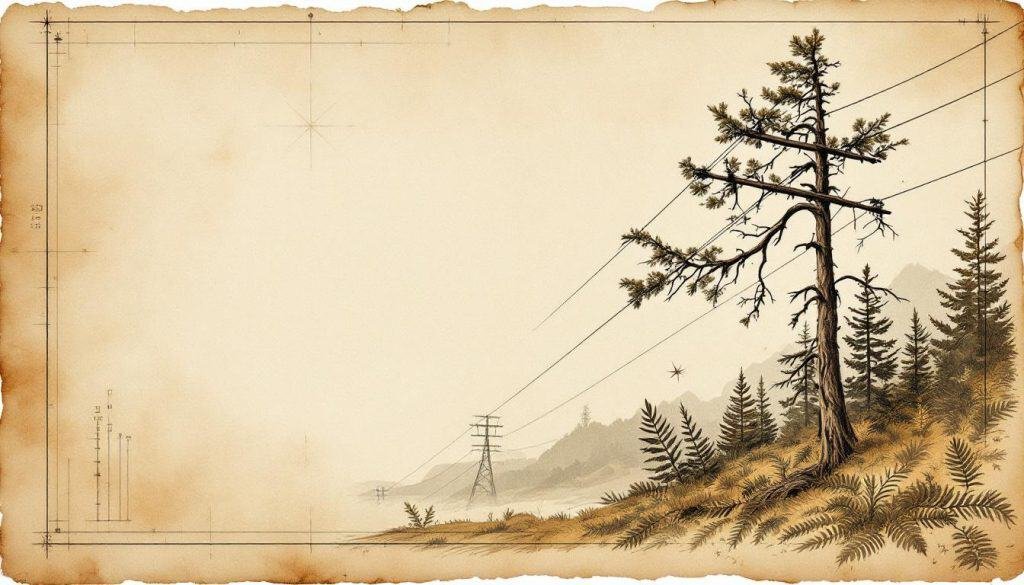
- Dead trees within one canopy length of power lines pose extreme wildfire ignition risk. Moisture drops to kiln-dry levels within 18 months, doubling flammability and ember cast distance. California law mandates 18–36 in clearance for 12 kV lines; utilities enforce 45-day removal for extreme hazards. Only line-clearance certified arborists may work within 10 ft of conductors—DIY attempts risk $5,000 fines. Schedule professional inspection by August 15 to beat bird-nesting restrictions and Santa Ana wind season.
That leaning pine behind your fence line feeds directly into the utility conductor, and last summer’s bark-beetle kill left it 100% fuel-dry. You can see the brown crown from the kitchen window, but what you can’t see is the 12,000-volt arc that can shoot 18 inches through humid air or the 300-foot ember cast once the trunk torches. Utilities across California are racing to map and remove these hazardous trees before the next wind event; this guide explains why dead-plus-power-line is a perfect-fire-storm, how to recognize the risk on your land, and exactly when to call a certified arborist such as myself, Michael Hartman, ISA Board Certified Master Arborist TX-0198B, before the utility contractor shows up with a 45-day notice.
By the end of this article you will know how drought, insects, and wind interact to turn ordinary green trees into explosive fuel poles, how utilities prioritize removal lists, what you can legally prune yourself, and the documentation you need to protect both your wallet and your liability if a tree on your parcel falls into energized lines.
Why Dead Trees Burn Hotter and Fail Faster
When a conifer dies, moisture content in the stem drops from roughly 120% (dry-weight basis) to 15–20% within 12–18 months in California’s Mediterranean climate. At that level the wood is twice as flammable as kiln-dried lumber. USGS aerial surveys following the 2012–2016 drought documented tens of millions of dead trees; the resulting heavy fuel loads now drive fires that exceed traditional model predictions. Once standing snags ignite, they burn like vertical chimneys, lofting 1–2 cm embers 0.3 km windward and up to 2 km downwind. A single 60-foot grey pine can produce 50 pounds of embers in the first ten minutes, enough to start spot fires across four residential lots.
Structurally, wood-decay fungi colonize sapwood within months of death, reducing modulus of rupture by 30–50% in the first three years. Combine that strength loss with a 60 mph Santa Ana gust and the tree now has only 25% of its original bending resistance. The failure point often occurs 6–12 feet above ground, exactly where the conductor passes, so the top third—loaded with dead needles—lands in the lines while the bottom remains rooted as a continuing hazard.
Term: A “hazardous tree” is any tree that has a defect that can cause it to strike a target and cause damage.
Utility Clearance Standards You Must Respect
California Public Utilities Commission General Order 95 mandates vertical and horizontal clearances that increase with voltage. For 12 kV distribution lines the minimum radial clearance is 18 inches under calm conditions and 36 inches at maximum sag or sway. High-voltage transmission lines (60 kV and above) require 10 feet minimum, expanding to 16 feet if fire-prone vegetation is present. These distances are measured from the nearest conductor surface, not the pole or cross-arm, and apply to any portion of the tree—living, dead, or broken—that could fall, sway, or be blown into the zone.
Utilities perform ground-based “patrol inspections” every year and detailed climbing or aerial inspections every 3–5 years. Dead or diseased trees rated “high risk” must be removed within 12 months; those rated “extreme” get 45 days. Failure to comply allows the utility to enter the parcel and bill the owner for all costs, often $3,000–$8,000 per tree. Property owners can negotiate alternatives—directional pruning, guy-wiring, or line insulation—but only if a certified arborist provides a written report demonstrating equivalent risk reduction.
| Line Voltage | Minimum Calm Clearance | Required Under Fire Weather |
|---|---|---|
| 4–21 kV distribution | 18 in / 46 cm | 36 in / 91 cm |
| 60–110 kV transmission | 10 ft / 3.0 m | 16 ft / 4.9 m |
| 220 kV + | 15 ft / 4.6 m | 20 ft / 6.1 m |
Reading the Tree’s Death Certificate
Start 360° from the ground. Recent beetle kill shows reddish-brown dust in bark fissures and popcorn-sized sap blobs on the lower 8 feet. Look for lightning scars, basal cankers, or fungal conks—any of these accelerate decay. Next, tilt your head back: a dead crown retains tight, needle-less twigs, whereas drought-stressed living crowns drop twigs and retain needles longer. Snap a ¼-inch twig; if it bends it’s alive, if it pops it’s dead. Finally, use a rubber mallet to strike the trunk at breast height: a crisp crack indicates sound wood, a dull thud signals advanced heart rot.
Height and lean matter. A dead 80-foot pine with 8° lean toward the line has a center-of-gravity already past the stump; it will fail at roughly 35 mph wind gust. Record the diameter at breast height (dbh) and plot the lean angle with a smartphone inclinometer; both numbers feed directly into the utility’s hazard algorithm.
Warning Signs to Watch For
- Bark beetle dust: Fine red-brown powder streaming from vertical galleries indicates active infestation and imminent crown fade.
- Crown transparency >50%: When you can see more sky than needles through the canopy, the tree is past recovery and will die within a year.
- Conk clusters at root flare: Shelf fungi such as Ganoderma mean butt rot; the tree can snap 3–4 feet above ground with no warning.
DIY vs. Line-Clearance Contractor
Homeowners may prune branches that are outside the utility clearance zone and that will not require climbing within 10 feet of a conductor. Anything closer demands a line-clearance certified arborist who has completed OSHA 1910.269 training. The rule is absolute: no ladders, pole saws, or bucket trucks operated by uncertified persons within the zone. Utilities patrol crews photograph violations and forward them to CPUC; fines start at $5,000 per incident.
If the tree is completely dead and taller than the distance to the line, do not attempt to fell it yourself. Line-clearance crews use insulated boom trucks, hot-line covers, and sometimes de-energize the circuit. They also calculate hinge thickness so the top lands away from the conductor; a 5° miscalculation can drop 2,000 pounds of wood across three phases and create an arc that will melt copper before the breaker trips.
Tools You Will Need
- Clinometer app: Measures trunk lean to nearest degree for hazard rating.
- Rubber mallet: For sounding trunk to detect internal decay.
- 100-ft fiberglass tape: Non-conductive and essential for accurate setback distances.
Timing: When Removal Is Urgent
October 1 through April 30 is the critical window. Santa Ana winds peak October–December, yet utilities require completion before May 1 when bird-nesting restrictions begin. Once a dead tree is flagged “extreme,” you have 45 calendar days; if that period overlaps a protected nesting window you must still complete removal, but only after a qualified biologist surveys and obtains a take permit—adding 2–3 weeks and $1,200–$1,800. Schedule your certified arborist inspection by August so the paperwork finishes before October winds.
Soil moisture matters too. Wet winter soils allow heavy equipment without compaction, while summer-dry soils may require plywood roads that add $500 per tree. Frozen ground at higher elevations can actually help; tracked lifts operate on 3-inch frost without rutting.
When to Act
Best window: August 15–November 15. Why this timing matters: permits close before nesting season, winds have not peaked, and soil still supports equipment access.
Paper Trail That Protects You
Request a written Tree Risk Assessment (TRA) conforming to ISA Best Management Practices. The report must list species, dbh, risk rating (low, moderate, high, extreme), recommended mitigation, and target (in this case the power line). Attach at least three photos: full crown, defect close-up, and conductor proximity. Submit the TRA to the utility vegetation-management contact listed on your bill; ask for written acknowledgment. Keep copies for insurance; many carriers now require proof of mitigation before renewing homeowner policies in high-fire zones.
If you disagree with the utility’s classification, you have 30 days to request an independent review conducted by a second Board Certified Master Arborist; the utility splits the cost. Document every email and inspection date—if a wildfire later originates from your tree, this file becomes your legal shield.
Pro Tip: Photograph the tree with a newspaper held against the trunk; the date stamp proves condition if the utility later claims you allowed further decline.
Cost Expectations and Who Pays
Utility crews remove only the portion necessary to maintain clearance; they leave the rest on the ground for you to dispose. A full removal by a private line-clearance arborist runs $150–$400 per dbh inch for pines, firs, and cedars up to 36 inches; oaks and eucalyptus cost 20% more due to wood density. Bucket-truck jobs average $2,800; crane removals over transmission lines can exceed $8,000. If the tree originated on your land, you pay. If it germinated naturally on a utility easement, the utility pays, but you must grant access.
Some counties offer cost-share grants for fuel-reduction work near critical infrastructure; check with your local fire-safe council. Grants reimburse 50–75% up to $10,000 per parcel, but require pre-approval before cutting.
Common Mistakes to Avoid
- Top-only cutting: Removing the crown but leaving a 30-foot snag creates a torched missile that can still strike the line—always remove to a 4-foot stump or ground level.
Ignoring the lean: Failure to measure lean angle underestimates windthrow potential; utilities downgrade your report and may still flag the tree.
What to Do Next
Walk your parcel this weekend and map every tree within two tree-heights of the nearest line. Photograph, measure dbh, and note lean direction. Email the set to a certified arborist who holds line-clearance qualification; request a TRA with 10-day turnaround. Submit the report to your utility before August 15. If removal is required, obtain three line-clearance bids and confirm each crew carries $2 million liability and workers’ comp. Schedule work for October–November, after nesting season closes but before peak winds. Keep all documentation in cloud storage; wildfire investigators will want to see it. Finally, replant only low-stature, low-resin species such as toyon or western redbud at least 20 feet from the corridor—breaking the fuel chain for the next generation.