A Field Guide to Tensioner Failure Felling Risks
Tensioner failure during tree felling creates unpredictable wood movement that injures even experienced operators. Learn to recognize, prevent, and respond t...
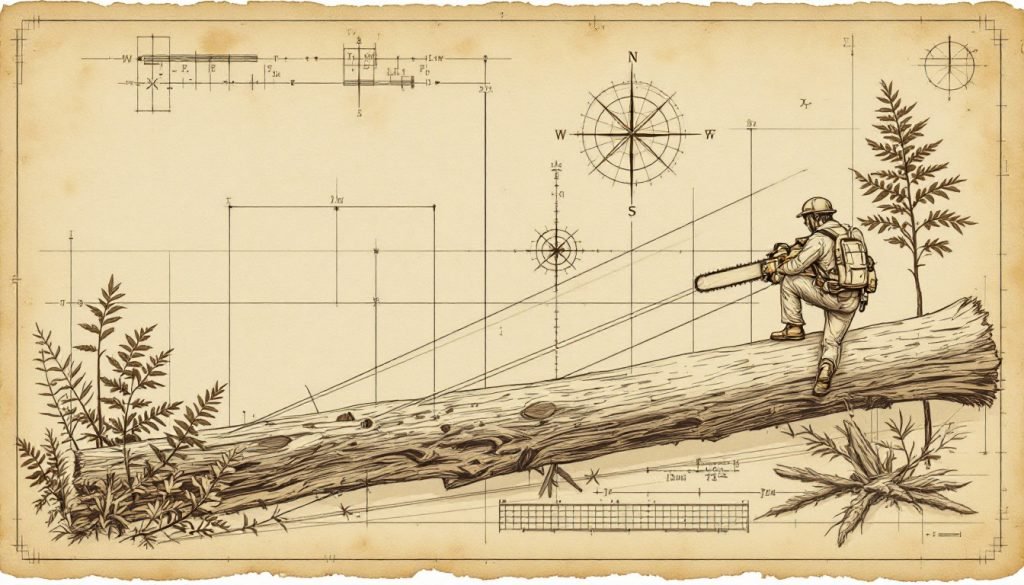
- Tensioner failure occurs when internal wood stress releases unpredictably during felling, causing violent or uncontrolled tree movement. Reaction wood in hardwoods like sweetgum, sycamore, and elm is the leading mechanical cause of barber-chair and bar pinch events. Compound lean, crown asymmetry, and root decay all shift internal stress in ways that visual trunk assessment alone will not reveal. Back cut geometry — positioned one to two inches above the face cut apex — and early wedge placement are the primary mechanical controls. For trees over 24 inches with visible reaction wood, significant lean, or decay, hire a credentialed arborist rather than proceeding independently.
Picture this: you have made your face cut, your back cut is progressing cleanly, and the tree is behaving exactly as planned — until it is not. The trunk shifts backward, pinches the bar with several tons of wood fiber, and the situation goes from controlled to dangerous in under a second. What you just experienced is tensioner failure, and it is one of the most underappreciated hazards in operational tree felling. It does not announce itself. It does not give you a warning buzzer. It exploits the gap between what you assumed the tree was doing internally and what it was actually doing.
Tensioner failure refers specifically to the collapse or reversal of the wood’s internal stress system at the moment of felling, causing the tree to move in a direction opposite to or inconsistent with the intended lay. This can manifest as bar pinch, barber-chair splitting, or sudden kickback of the butt end — each carrying serious injury potential. The forces involved are not trivial. A 24-inch diameter hardwood trunk can exert thousands of pounds of lateral pressure on a chainsaw bar in milliseconds when internal tension releases unexpectedly.
In this guide, ISA Board Certified Master Arborist Michael Hartman breaks down the mechanical reality behind tensioner failure, the tree conditions and operator errors that make it more likely, and the field protocols that reduce your exposure. Whether you are a property owner felling a single storm-damaged tree or a climbing arborist managing a complex removal, understanding tensioner dynamics is non-negotiable for safe operations.
The Mechanical Reality: Why Wood Tension Exists in Standing Trees
Every standing tree is a structure under load. Gravity, wind history, crown asymmetry, and root anchorage all contribute to a state of internal stress that the tree has spent years — sometimes decades — building into its wood fibers. This stress is not uniform. Compression wood forms on the underside of a lean, while tension wood develops on the upper side. In hardwoods, tension wood is particularly pronounced and can be difficult to identify visually because it often looks identical to normal wood on the surface.
When you begin a felling cut, you are interrupting that stress equilibrium. The hinge wood you intentionally leave is supposed to act as a controlled release mechanism, guiding the tree’s fall direction by managing how and when those stresses resolve. The tensioner — the zone of wood fiber under tension on the back side of the lean — is supposed to stretch and then release gradually as the tree tips. When it fails prematurely, releases asymmetrically, or was never where you assumed it was, the tree moves in ways your cut geometry did not account for.
Reaction wood is the primary culprit in most tensioner failure events. In conifers, compression wood on the underside of a lean is brittle and can fracture suddenly rather than bending. In hardwoods like oak, hickory, and sweetgum, tension wood on the upper side of a lean is extraordinarily strong and fibrous — it resists cutting, dulls chains faster, and can hold the tree suspended at an angle far longer than expected before releasing all at once. That sudden release is the failure event.
Tensioner Failure: The sudden, uncontrolled release of internal wood stress during felling, causing the tree to move in an unintended direction — most commonly resulting in bar pinch, barber-chair splitting, or butt kickback.
Reading Lean and Stress Before You Cut
Accurate lean assessment is the first line of defense against tensioner failure. Most operators assess lean visually from one or two positions, which is insufficient for trees with compound lean — a primary lean in one direction combined with a secondary lean offset by 15 to 45 degrees. A tree that appears to lean directly away from a structure may actually carry significant lateral tension that will pull the crown sideways during the fall. Use a plumb bob or a dedicated lean indicator tool and assess from at least three positions around the tree.
Crown weight distribution matters as much as trunk lean. A tree with a straight trunk but a crown that is 70 percent heavier on one side is effectively a leaning tree from a stress standpoint. Walk the perimeter and look up. Identify where the bulk of the crown mass sits. In deciduous trees during leaf-off season, this is easier to assess accurately — another reason why winter felling is often preferred for complex removals. During full leaf, you are estimating, and your margin for error shrinks accordingly.
Root system condition also affects internal stress patterns in ways that are not always visible. A tree with significant root decay on the windward side has likely developed compensatory tension wood on the opposite side as a structural response. If you see conk fruiting bodies, soil mounding, or previous root damage, treat the internal stress distribution as unknown and plan your cut sequence conservatively.
Warning Signs of High Tensioner Failure Risk
- Compound or off-axis lean: Trunk leans one direction but crown mass pulls laterally — creates unpredictable stress release during the back cut.
- Reaction wood at the cut face: Wavy, woolly, or discolored wood fibers visible at the face cut indicate tension wood — expect the bar to bind and the tree to move erratically.
- Previous storm damage or crown loss: Asymmetric crown from past breakage shifts the center of gravity away from the visible lean axis.
- Root decay indicators: Conks, soil heaving, or soft spots at the base suggest the tree has developed compensatory tension wood internally as a structural response.
- Slow or stalled back cut: If the saw labors or the kerf begins closing before the tree moves, tension is releasing into the bar rather than into the hinge — stop and reassess.
The Barber-Chair Failure Mode
Barber-chairing is the most violent expression of tensioner failure and one of the most dangerous events in ground-level felling. It occurs when the back cut releases tension wood faster than the hinge can control the fall, causing the trunk to split vertically upward from the back cut before the tree has rotated far enough to clear the stump. The butt end of the trunk kicks backward — directly toward the operator — while the top falls forward. The split can travel six feet or more up the trunk in under a second.
Species with long, interlocked grain are most susceptible. Sweetgum (Liquidambar styraciflua), sycamore (Platanus occidentalis), and elm (Ulmus spp.) are notorious for barber-chairing because their tension wood fibers run in spiraling, interlocked patterns that resist clean transverse cutting. When the back cut reaches a critical threshold, those fibers do not sever — they tear longitudinally, and the split propagates upward explosively. Eucalyptus species introduced in urban landscapes across the southern and western United States carry similar risk.
Preventing barber-chair events requires leaving adequate hinge width — typically 10 percent of the tree’s diameter — and making the back cut slightly above the apex of the face cut rather than at the same level. This geometry keeps the hinge intact longer during the initial rotation. Using a felling wedge or two wedges driven alternately as the back cut progresses also maintains control by preventing the kerf from closing and by initiating the fall before tension wood can accumulate stress at the cut face.
Pro Tip: On any tree showing woolly or discolored wood at the face cut — classic tension wood indicators — drive your first plastic felling wedge into the back cut kerf within the first two inches of cutting. Do not wait until the bar is halfway through. Getting that wedge in early keeps the kerf open and gives you a mechanical advantage before the tension wood has a chance to close on the bar. I have used this approach on sweetgums and sycamores for thirty years and it has prevented more pinch events than I can count.
Bar Pinch: The Slow-Motion Tensioner Failure
Not every tensioner failure is explosive. Bar pinch — where the kerf closes on the chainsaw bar during the back cut — is a slower, quieter failure mode that is equally dangerous because it immobilizes your saw and leaves you in close proximity to a tree that is now in an unstable, partially cut state. Bar pinch happens when the tree’s weight settles into the back cut rather than rotating away from it, compressing the kerf around the bar with enough force to stall the chain and trap the saw.
This typically occurs when the operator has misjudged the lean direction, when wind shifts the crown during cutting, or when the face cut is too shallow to allow the hinge to initiate rotation before the back cut reaches the hinge wood. A face cut that opens only 60 degrees instead of the recommended 70 to 80 degrees leaves less room for the tree to begin tipping before the back cut closes the gap. The geometry works against you.
Recovery from bar pinch requires a second saw if available, or a hand saw to relieve pressure from a different angle. Never attempt to force the pinched saw free by revving the engine — this risks chain breakage and bar damage, and the sudden release of tension if the tree shifts can throw the saw unpredictably. Drive additional wedges above the bar to open the kerf before attempting extraction.
Cut Sequence Errors That Amplify Tensioner Risk
The order and geometry of your cuts determine whether internal wood stress works with you or against you. The most common sequencing error is making the back cut at exactly the same height as the apex of the face cut. This eliminates the step that keeps the hinge engaged during early rotation and dramatically increases the probability of barber-chairing in tension wood species. The back cut should be positioned one to two inches above the face cut apex — a small adjustment with significant mechanical consequences.
Cutting through the hinge is the other critical error. Operators under time pressure or working with a dull chain sometimes push the back cut too far, severing the hinge wood entirely before the tree has built enough rotational momentum to fall cleanly. Without the hinge, the tree is essentially a free-falling object with no directional control. In a confined space or near structures, this is catastrophic. Mark your hinge boundaries before you begin cutting and stop the back cut with two to three inches of hinge remaining on each side.
Cut Sequence Errors That Amplify Tensioner Risk
- Back cut at face cut height: Eliminates the mechanical step that keeps the hinge engaged during initial rotation — position the back cut one to two inches above the face cut apex instead.
- Cutting through the hinge: Removing hinge wood entirely before the tree has rotational momentum turns a controlled fall into a free-fall — mark hinge boundaries before cutting and stop with two to three inches remaining.
- Shallow face cut angle: A face cut opening less than 70 degrees reduces the distance the tree can rotate before the back cut closes — use 70 to 80 degrees as your standard geometry.
- No wedge in the back cut: Skipping felling wedges on tension wood species allows the kerf to close on the bar before the tree moves — drive a wedge within the first two inches of the back cut on any high-risk tree.
Personal Protective Equipment and Escape Route Planning
Tensioner failure events happen fast enough that PPE and pre-planned escape routes are your last line of defense when everything else goes wrong. The escape route should be established and cleared before the first cut is made — not improvised after the tree starts moving. Standard protocol calls for two escape routes positioned at 45-degree angles to the rear of the intended fall direction, each cleared of tripping hazards for a minimum of 15 feet. When the tree begins to move, you move immediately, keeping your eyes on the tree and your back to the fall direction only after you have reached safe distance.
Chainsaw chaps rated to ASTM F1897 or EN 381-5 Class 1 or higher are mandatory for any ground-level felling operation. A properly fitted hard hat with integrated face shield and hearing protection reduces injury severity from flying debris during barber-chair events. Kevlar-reinforced gloves protect against chain contact during bar pinch recovery. None of this equipment prevents tensioner failure — but it meaningfully changes the outcome when failure occurs. For comprehensive safety standards, consult OSHA chain saw guidelines and Extension chainsaw safety resources.
When to Stop and Reassess
Knowing when not to proceed is as important as knowing how to cut. If your pre-cut assessment reveals compound lean you cannot fully characterize, significant root decay, or crown damage that has shifted the center of gravity in an unknown direction, the correct decision is often to stop and bring in additional equipment or expertise. A single-stem pull line rigged to a truck or tractor can provide enough directional force to override moderate tensioner uncertainty. A two-line system with a redirect block gives you even more control over fall direction.
Trees over 24 inches in diameter with visible reaction wood, significant lean, or decay indicators are genuinely high-risk felling operations. For property owners, this is a clear threshold for hiring a licensed arborist with felling experience rather than attempting the work independently. The cost of a professional removal is a fraction of the cost of a medical emergency or structural damage claim. For arborists, these are the trees that warrant a pre-cut team briefing, a written hazard assessment, and documented escape route planning before the saw starts.
Pre-Felling Tensioner Risk Assessment Checklist
- Assess lean from three positions using a plumb bob or lean indicator — identify compound lean before cutting
- Evaluate crown weight distribution during full perimeter walk — note asymmetric mass that does not align with trunk lean
- Inspect root zone for decay indicators: conks, soil heaving, soft spots, previous mechanical damage
- Check face cut wood for woolly texture or discoloration indicating tension wood — adjust cut sequence and wedge strategy accordingly
- Confirm face cut angle is 70 to 80 degrees and back cut will be positioned one to two inches above face cut apex
- Clear and walk both escape routes before first cut — minimum 15 feet at 45-degree angles to the rear of intended fall
- Stage felling wedges and a second saw or hand saw within reach before beginning the back cut
Building a Safer Felling Practice
Tensioner failure is not a freak accident. It is a predictable outcome of specific conditions — reaction wood, compound lean, cut sequence errors, and inadequate mechanical support — that can be identified and managed before the first cut is made. The operators who get hurt are rarely the ones who ignored all the rules. More often, they are experienced people who got comfortable with a process that worked on simpler trees and did not recalibrate when the variables changed.
The field guide approach to tensioner risk means treating every tree as its own engineering problem. Assess the lean, read the wood, plan the cut geometry, stage your wedges, clear your escape routes, and stay alert to feedback from the saw during the cut itself. A bar that starts laboring, a kerf that begins closing, or a tree that hesitates when it should be moving are all signals to stop, reassess, and adjust. The saw can be replaced. The operator cannot.
For complex removals — large-diameter trees, significant lean toward structures, visible decay, or any combination of these factors — consult a credentialed arborist before proceeding. ISA certification and TCIA membership are baseline indicators of professional training in exactly these scenarios. The goal is not just to fell the tree. The goal is to fell the tree and walk away.