Choosing Between Felling or Skidding Workflow
Understand how rubber-tired feller-bunchers, grapple skidders, knuckleboom loaders, and trucks work together to harvest trees efficiently and safely.
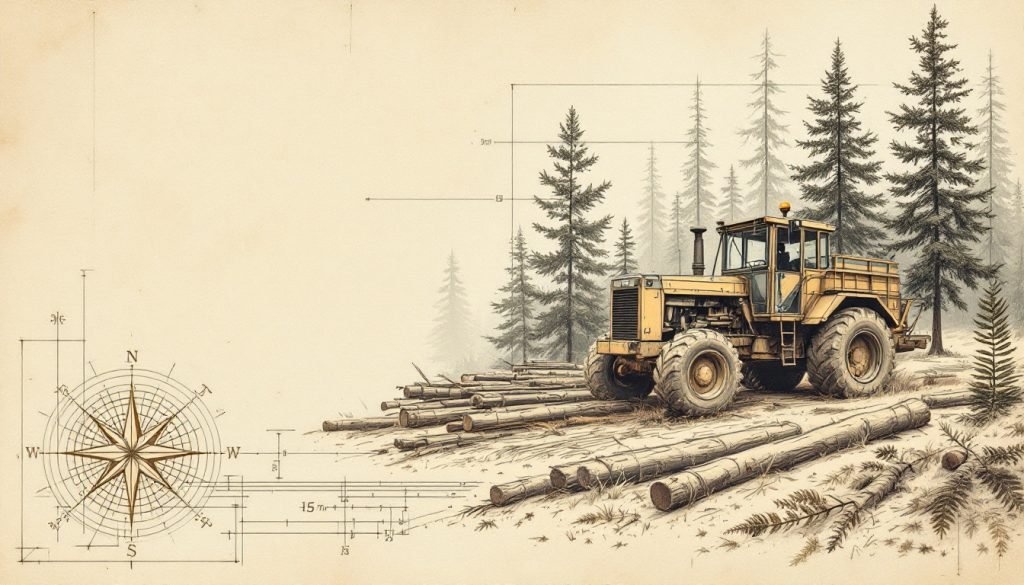
- Feller-bunchers cut 150 tons/day vs 25 tons for chainsaw crews. Rubber-tired carriers exert 6.5–8.3 psi—enough to rut wet clays. Grapple skidders can move 15 cords per turn on 15% slopes. Alternate skid trails every 100 ft on slopes over 10%. For tracts under 40 tons, request self-loading trucks to avoid loader fees.
You have a stand of mature pines or mixed hardwoods and the forester just said “thinning time.” Suddenly you need to picture what machines will roll onto your land, how they will cut, move, and load the timber, and what each piece of equipment actually costs to run. As an ISA Board-Certified Master Arborist who has watched the evolution from chainsaw crews to fully mechanized harvests across Texas, I will walk you through the four core machines you will meet on a modern cut block and explain exactly what each one does.
Why Mechanized Harvesting Dominates the South
Forest economists track harvesting cost down to dollars per ton. A two-man chainsaw crew can fell and de-limb roughly 25 tons per day on gentle terrain, while a single rubber-tired feller-buncher routinely tops 150 tons in an eight-hour shift. That six-fold productivity jump explains why more than 85% of the commercial harvests from East Texas to the Carolina coast now start with a feller-buncher head mounted on a 160–210 hp carrier. Mechanized systems also reduce insurance exposure: fewer humans standing under suspended stems and less manual chain-saw work translate to lower workers-comp premiums for both logger and landowner.
From a silvicultural standpoint, the precision of a disc-saw felling head protects residual trees during thinning operations. The operator can grab, shear, and lay a 14-inch pine down between two leave trees with less than 6 inches of crown contact, something a sawyer with a 36-inch bar simply cannot replicate. The result is faster closure of skid trails, less soil compaction, and higher post-harvest stand quality.
Term: A fer-buncher is a self-propelled machine equipped with a grabbing device and a cutting head that can sever, hold, and stack multiple stems in one motion.
Feller-Buncher: the Cut-and-Stack Specialist
The rubber-tired or drive-to-tree feller-buncher is the most common felling machine across the South because it moves at 5–7 mph on improved woods roads and can cover up to 40 acres per day in plantation rows. An accumulator head can hold four to seven 8-inch pines before laying the entire bunch parallel to the in-woods trail for the skidder. The disc saw slices through a 20-inch hardwood in under three seconds, so cycle times average 45–60 seconds per tree from first grasp to final stack.
When you select a contractor, check the head type. A high-speed disc saw excels on clean pines but will shatter brittle red oak if the chain is dull; a shear blade with a replaceable knife is better for hardwood stands. Tire width matters too: 28-inch flotation tires exert 6.5 psi ground pressure while 24-inch tires jump to 8.3 psi—enough to rut wet clay soils in the first week of the job.
Pro Tip: Ask the operator to cut a few test stems and inspect the stump face. A smooth, sloped cut 2–3 inches above the root flare reduces fungal ingress and speeds closure compared with a low, ragged hinge that tears bark down the trunk.
Grapple Skidders: Moving Wood to the Landing
Once trees are bunched, a grapple skidder drags the stems to the landing. The classic six-wheel model develops 24 000 lb of draw-bar pull and can snake 12–15 cords of pine up a 15% slope on a wet clay skid road. A cable skidder is cheaper to buy, but the operator must wrap chokers around each stem; on plantation rows a clam-bunk grapple can pick up the entire pre-bunched pile in one bite, dropping cycle time to 4–5 minutes per turn.
Pay attention to tire ballast. Many crews fill the rear tires with calcium chloride brine, adding 1 800 lb per tire for extra traction, but that weight also increases soil rutting on loamy soils. Request that the skidder operator alternate skid trails every 100 feet on slopes steeper than 10%, and keep slash mats on the trail to spread the 13 psi tire pressure over a wider footprint.
Skid-Trail Best Practices
- Space primary trails 300–400 ft apart in pine plantations
- Lay slash at least 6 inches deep on the wheel path
- Keep skid speed under 5 mph to reduce bark shear
- Stop skidding when soil moisture exceeds 28% by weight
Knuckleboom Loaders: Decking and Loading Trucks
At the landing, a knuckleboom loader sorts and decks stems by product class—pulpwood, chip-n-saw, or sawlogs—then swings them into an awaiting log truck. Modern loaders use a 30-foot boom with 360° rotation and can stack wood 24 feet high, buying the crew extra deck space during wet weeks when trucks are late. A single loader can process 70–90 tons per hour, matching the combined output of two feller-bunchers.
Loader cost runs about $235 per scheduled machine hour (SMH) including fuel and operator, so contractors aim to keep utilization above 75%. If your tract is small—say under 40 tons—ask whether the logger will bring a self-loading log truck instead; the integrated boom eliminates the loader entirely and saves you a $500 move-in fee.
Log Trucks: Hauling to Mill
A standard five-axle south-eastern log truck carries 25–28 tons of pine pulpwood legally at 80 000 lb gross weight. The logger is paid per ton delivered, so payload efficiency drives profit; every extra 500 lb of tarp chains or worn bunk stakes costs roughly $1.25 per load in lost revenue. Trucks must comply with both DOT axle-weight limits and individual mill bark-thickness rules—some mills reject loads if residual bark exceeds 1 inch after in-woods debarking.
For landowners, the key metric is truck turn-around time. A tract located 45 miles from the mill equals roughly $11 per ton in haul cost at current diesel prices; push the haul to 90 miles and hauling jumps to $20 per ton, often erasing the stumpage premium for distant tracts. Always verify that the logger has a back-haul contract; empty return trips double your per-ton haul cost and can delay payment for weeks.
Matching Equipment to Stand and Soil Conditions
Choose a contractor whose machines fit your terrain. On flat coastal plain sands, a wheeled feller-buncher and grapple skidder set is cheapest. In the Piedmont with 25% slopes and rocky soils, switch to a tracked feller-buncher and a small cable skidder to reduce slippage and soil disturbance. For hardwood shelterwood stands scattered with 30-inch oaks, insist on a disc-saw head with 24-inch capacity so the operator can make one clean shear instead of multiple notches that scar residual trees.
Soil texture matters. Loamy soils rutted deeper than 6 inches will pond water and stunt replanted seedlings for two growing seasons; insist on slash mats or temporary corduroy from small tops on primary skid trails. On clay soils, schedule harvests during the dry window—usually late August through early October in the Gulf states—to avoid glazing the skid trail surface into a brick-hard layer that repels water and seed.
Professional vs. Landowner Equipment Decisions
A common question is whether a landowner should buy or lease harvesting equipment. A new 200 hp feller-buncher with a hot-saw head retails around $550 000 and burns 6.5 gal of diesel per productive machine hour (PMH). Add payments, insurance, and maintenance and you are looking at $180 per PMH before labor. Unless you have 500+ acres to harvest annually, owning rarely beats hiring a bonded, insured contractor who carries the depreciation risk.
If you do contract the job, request the crew’s South Carolina Master Logger or comparable state certification, verify $2 million liability insurance, and insist on a written harvesting plan that shows leave-tree markings, skid-trail locations, and stream-management zones. A reputable operator will provide all three without hesitation; absence of any one is a red flag.
What to Do Next Before the Sawyers Arrive
Walk the stand with your forester and flag every boundary and stream-side management zone (SMZ) with fluorescent orange tape at eye level. Take date-stamped photos of any structures within 150 feet of the harvest area; this protects both you and the logger if a stray stem dents a barn roof. Finally, get the complete equipment list—make, model, and year—of every machine that will enter your property. Knowing whether the skidder is a 2006 cable machine or a 2022 clam-bunk model tells you exactly what soil protection to demand and what production rate to expect. With those details locked in, you can sign the timber contract confident that the right machines will harvest your wood quickly, safely, and with minimal impact on the next forest you are already growing.
Still weighing feller-buncher vs skidder priorities for your tract? Match machine capabilities to stand size, slope, and soil before the first stem hits the ground.