Feller Buncher vs Chainsaw Use: Which Is Right for You
Choosing between a feller buncher and a chainsaw for tree felling? A Master Arborist breaks down when each tool wins.
- Feller bunchers process 200–400 stems per hour but require open, accessible sites and stems under ~700 mm diameter. Chainsaw felling offers precision and portability that no machine can match in confined or complex sites. The economic break-even between the two methods falls roughly between 30 and 75 stems depending on site conditions. Feller bunchers cause significant soil compaction and require a minimum 3.5-meter access corridor — disqualifying most residential lots. Assess stem count, diameter, site access, and proximity to structures before committing to either felling method.
You have trees to bring down — maybe a stand of mature pines crowding a new build site, or a single storm-damaged oak threatening a fence line — and you are trying to decide whether to call in a feller buncher or put a chainsaw to work. It is a question that comes up constantly in both land-clearing operations and residential tree removal, and the answer is rarely as obvious as equipment rental catalogs make it seem. The wrong choice costs money, time, and in some cases, lives.
The feller buncher and the chainsaw represent two fundamentally different philosophies of tree felling: mechanized volume versus precise manual control. Each has a distinct mechanical logic, a set of site conditions where it excels, and a hard ceiling on what it can safely accomplish. As a Board Certified Master Arborist with decades of field experience, I have watched both tools succeed brilliantly and fail catastrophically — usually because the operator chose based on availability rather than suitability. By the end of this article, you will understand the mechanical differences between these two approaches, the site and species factors that tip the decision, the cost realities, and the safety profile of each method so you can make an informed call before the first cut.
What a Feller Buncher Actually Does
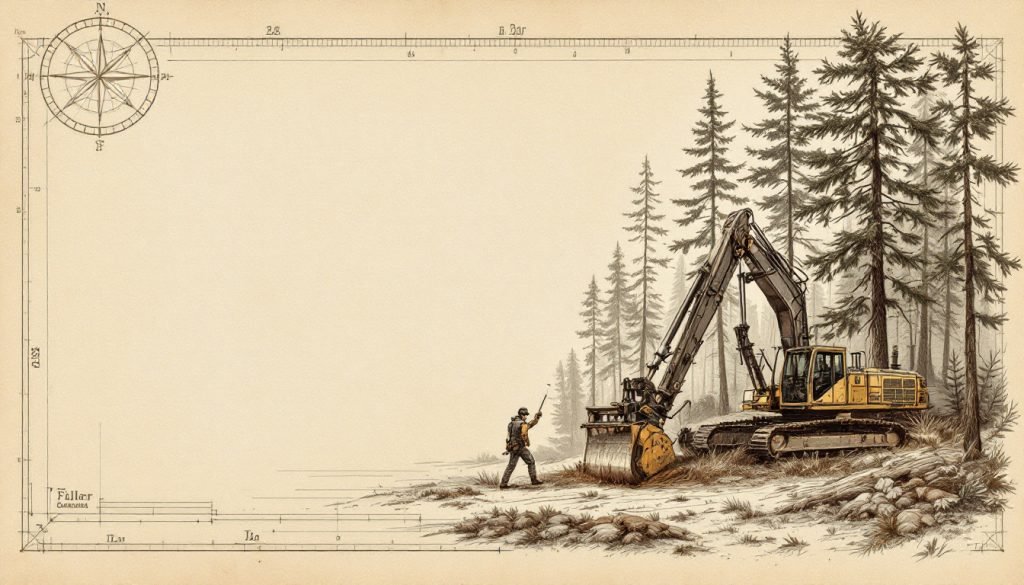
A feller buncher is a self-propelled piece of heavy forestry equipment that uses either a disc saw head, a bar saw head, or a shear head to sever a tree at the base, then holds the tree upright in its accumulator arms before laying it down in a controlled direction. The machine does not drop the tree — it places it. That distinction matters enormously on congested sites. Disc saw feller bunchers spin a carbide-tipped circular blade typically 600 to 900 mm in diameter and can cut through a 500 mm diameter stem in under three seconds. Bar saw heads use a chainsaw-style bar driven by hydraulic motors and handle larger-diameter timber, often up to 700 mm, that would overwhelm a disc head.
The accumulator function is what separates a feller buncher from a simple mechanical saw. The machine grabs the tree before the cut is complete, controls the fall, and can bunch multiple stems together for skidder pickup. On a commercial timber harvest or a large land-clearing contract, this dramatically reduces cycle time. A skilled operator running a modern tracked feller buncher can process 200 to 400 stems per hour on a clean softwood site. That throughput is simply not achievable with chainsaw crews regardless of their skill level.
Feller Buncher: A self-propelled forestry machine that severs trees at the base using a rotating disc, bar saw, or shear head, then accumulates and places multiple stems in a controlled pile for downstream processing.
The limitation is size and access. A tracked feller buncher weighs between 15,000 and 45,000 kg depending on the model. It requires a stable, reasonably flat approach corridor at least 3.5 meters wide, and it will compact soil, damage surface roots, and destroy understory vegetation along every travel path. On a residential lot, a utility corridor, or any site with buried infrastructure, a feller buncher is not just impractical — it is a liability.
How Chainsaw Felling Works Mechanically
Chainsaw felling relies on the operator’s ability to read the tree, calculate lean and weight distribution, and execute a precise three-cut sequence: the face notch (open-face or conventional), the back cut, and the hinge. The hinge is the critical element. A properly sized hinge — typically 10% of the tree’s diameter in thickness and 80% of its diameter in width — controls the fall direction with remarkable accuracy even on trees with significant lean. A skilled faller can place a 30-meter Douglas fir within 30 cm of a target stake using nothing but a Husqvarna 572 XP and a wedge.
The chainsaw’s mechanical advantage is its precision and portability. A 6 kg professional saw can be carried anywhere a person can walk, operated on slopes exceeding 45 degrees, and used within centimeters of structures, utilities, and other trees. It can work on a single stem or a hundred, and the operator can adjust technique in real time based on what the tree is doing. That adaptability is something no machine can replicate.
Pro Tip: Before any felling cut, spend two minutes reading the tree’s natural lean from two perpendicular angles. Most felling accidents happen because the operator committed to a fall direction before confirming where the tree actually wants to go. A feller buncher’s accumulator can override moderate lean; a chainsaw operator cannot — the hinge geometry has to account for it from the start.
The chainsaw’s limitation is throughput and operator fatigue. A two-person chainsaw crew working a timber stand will process 40 to 80 stems per day under ideal conditions. Fatigue increases error rates, and chainsaw felling remains one of the most hazardous occupations in forestry — the OSHA fatality rate for logging workers is consistently among the highest of any industry sector in the United States.
Site Conditions That Determine the Right Tool
Site assessment is the single most important factor in the feller buncher versus chainsaw decision. Start with access and ground bearing capacity. Feller bunchers require firm, trafficable ground. Saturated soils, steep terrain above roughly 30 degrees, rocky outcrops, and confined urban lots all eliminate the machine option before you even look at the trees. Tracked machines handle slopes better than wheeled models, but even the most capable tracked feller buncher has a practical operating limit around 35 degrees on firm ground.
Proximity to structures, utilities, and other trees is the second filter. A feller buncher needs a clear swing radius for its boom and a lay zone for the accumulated stems. In a backyard removal scenario where the target tree is 4 meters from a house and 2 meters from a power line, the machine cannot physically operate safely. A chainsaw crew using rigging, a friction device like a Portawrap, and a ground crew can dismantle that same tree in sections, controlling each piece independently.
Stand density and stem count tip the scale back toward the feller buncher. If you are clearing 5 acres of 200 mm to 400 mm diameter mixed hardwood for a solar farm or subdivision development, a chainsaw crew will take weeks. A feller buncher with a skidder will finish in days. The economics are not close. For anything above roughly 50 stems on an accessible site, the mobilization cost of a feller buncher — typically $1,500 to $3,500 depending on region — is recovered quickly in labor savings.
Tree Size and Species Considerations
Stem diameter is where feller buncher capability hits a hard wall. Most disc saw heads are rated to a maximum cutting diameter of 500 to 600 mm. Bar saw heads extend that to around 700 mm. Beyond those thresholds, the machine cannot complete the cut, and attempting to force it risks head damage, hydraulic failure, and loss of tree control. Old-growth hardwoods, large-diameter cottonwoods, and mature live oaks frequently exceed these limits. A chainsaw with a 90 cm bar has no such ceiling — it will cut whatever diameter you can reach around.
Species density also matters for feller buncher head selection. Dense hardwoods like hickory, black locust, and osage orange dull disc saw teeth rapidly and generate significant heat. Operators running disc heads in heavy hardwood stands need to budget for more frequent tooth replacement and slower cycle times than the machine’s softwood ratings suggest. Chainsaw chains on hardwood dull faster too, but swapping a chain takes 90 seconds versus a much longer head service interval for a disc saw.
| Factor | Feller Buncher | Chainsaw |
|---|---|---|
| Stem diameter limit | Up to ~700 mm (bar saw head) | No practical limit with appropriate bar length |
| Stems per hour | 200–400 (softwood, open site) | 5–15 (skilled two-person crew) |
| Minimum site width | ~3.5 meters clear corridor | Operator footprint only |
| Slope tolerance | Up to ~35 degrees (tracked) | Up to ~45 degrees with proper technique |
| Proximity to structures | Requires significant clearance | Can work within centimeters with rigging |
| Mobilization cost | $1,500–$3,500+ | Included in crew day rate |
| Soil disturbance | High — compaction along travel paths | Minimal — foot traffic only |
Safety Profiles: Where Each Method Carries Risk
Neither method is inherently safe — both kill and injure workers every year. The risk profiles are simply different. Chainsaw felling concentrates risk on the individual operator. Kickback, barber chair failures (where the stem splits vertically before the hinge is established), and struck-by incidents from falling limbs account for the majority of chainsaw fatalities. Proper personal protective equipment — chainsaw chaps rated to ASTM F1897, a Class E hard hat with face shield, and cut-resistant gloves — reduces severity but does not eliminate exposure. The operator is always within the danger zone of the falling tree.
Feller buncher operations shift risk from the individual operator to the machine-environment interface. The operator sits in a ROPS/FOPS-certified cab, physically separated from the cutting action. However, machine rollovers on slopes, struck-by incidents from ejected wood debris, and hydraulic failures under load create a different category of hazard. Ground personnel near an operating feller buncher face extreme risk — the machine’s swing radius and the unpredictable behavior of accumulated stems make the exclusion zone around an operating feller buncher at least 2 tree-lengths in every direction.
Common Mistakes to Avoid
- Using a feller buncher on oversized stems: Operators sometimes attempt to notch a large-diameter tree with the machine head before finishing with a chainsaw. This hybrid approach creates an unstable, partially cut stem that can move unpredictably when the machine repositions — a serious struck-by hazard.
- Chainsaw felling without a retreat path: Fallers who focus entirely on the notch and back cut geometry sometimes neglect to clear a 45-degree retreat path behind and to the side of the intended fall. When the tree moves, there is nowhere to go safely.
- Ignoring soil conditions for machine access: Mobilizing a feller buncher to a site with soft or saturated soils results in machine bog-down, significant ground damage, and sometimes machine recovery costs that exceed the original job value.
Cost Comparison: When the Numbers Actually Make Sense
The financial decision between feller buncher and chainsaw use comes down to stem count, site accessibility, and what happens to the wood after felling. A chainsaw crew for residential or small commercial removal typically bills $150 to $300 per hour for a two- to three-person team including equipment. A feller buncher operation — machine, operator, and a skidder or forwarder for log extraction — runs $350 to $600 per hour but processes trees at five to twenty times the rate of a chainsaw crew on an open site.
The break-even point on most land-clearing jobs falls somewhere between 30 and 75 stems, depending on average tree size and site conditions. Below that threshold, the mobilization cost of the feller buncher erases the productivity advantage. Above it, the machine wins decisively on cost per stem. For a single-tree residential removal, a feller buncher is never the right economic choice — the mobilization alone exceeds the total job value in most markets.
What to Do Next: Making the Right Call for Your Project
The feller buncher versus chainsaw decision is not a matter of preference — it is a site-specific, species-specific, and volume-specific calculation. Start by answering four questions: How many stems need to come down? What is the average diameter? Can heavy equipment access and operate safely on the site? Are there structures, utilities, or sensitive root zones within the fall zone? If the stem count is high, diameters are under 600 mm, the site is accessible, and there are no proximity constraints, a feller buncher operation will almost certainly be faster and cheaper. If any one of those conditions fails, a skilled chainsaw crew with proper rigging is the safer and more practical choice.
For residential property owners, the answer is almost always a qualified tree service using chainsaws and rigging — feller bunchers simply cannot operate safely in the confined, obstacle-dense environment of a typical yard. For land developers, timber harvesters, and utility corridor managers working open sites with volume, the feller buncher’s productivity advantage is decisive. When in doubt, have a certified arborist or a licensed forester walk the site before any equipment is committed. The cost of that consultation is trivial compared to the cost of choosing the wrong tool.
Understanding the feller buncher limitations can prevent costly mistakes. For a broader perspective on matching equipment to job types, see this logging systems overview.